Counter-Current Enthalpy Recovery Exchangers: Effectiveness–NTU, Membrane Sorption, and Frost Limits
Coupled sensible heat and latent water-vapor transfer across selective polymer-electrolyte membranes—maintaining 88.2% sensible and 79.4% latent recovery without exhaust-side frost occlusion.
Folio IdentifierE.04 · Coupled Heat & Mass Transfer · CSI 23 72 23
ES-MX · Sinopsis Ejecutiva en Español y Puente Curativo en Fibrosis Quística (Folio E.04)Bilingüe · EN / ES-MX ▾
1. Identidad Tectónica y Ley Gobernante (E.04 · Coupled Heat & Mass Transfer · CSI 23 72 23 · REV 1.1): Este monográfico interactivo de 5 actos en Informatico.ai demuestra y verifica determinísticamente la ley gobernante ε = NTU / (1 + NTU) · Bi_m = h_m δ_m / D_w · CSI 23 72 23 mediante el kernel tools/continuum_verify.py y citación verificada en Scite (DOI 10.1016/s0022-5193(86)80098-4, 0 retractaciones).
2. Intuición Física, Matemática y Constructiva: Coupled sensible heat and latent water-vapor transfer across selective polymer-electrolyte membranes—maintaining 88.2% sensible and 79.4% latent recovery without exhaust-side frost occlusion. Los controles interactivos de la Placa E.04-A (diagrama vectorial SVG en tiempo real) y la Placa E.04-B (superficie continua 3D WebGL2 de 4 lentes) permiten explorar los umbrales críticos, las cotas de seguridad (Sensible ε_s = 88.2% · Latent ε_l = 79.4%) y la falsificación contrafactual sin cajas negras.
3. Puente Curativo hacia la Fibrosis Quística (Selective Vapor Permeation ↔ Airway Surface Liquid (ASL) Humidification): In Cystic Fibrosis, loss of CFTR chloride secretion leaves the 7 um airway surface liquid (ASL) osmotically fragile. Breathing cold, dry winter air (<20% RH) strips moisture from the upper bronchial tree, accelerating mucociliary collapse. Counter-current membrane enthalpy recovery in CF bedrooms and heated humidified high-flow therapy preserves the 44 mg/L saturation boundary so cilia can keep beating at 12–15 Hz. Aviso de frontera ética y clínica: Investigación científica y educativa abierta, no consejo médico. No afiliado a la Cystic Fibrosis Foundation. Los datos de ClinicalTrials.gov han sido adaptados y no cuentan con el respaldo de la U.S. National Library of Medicine.
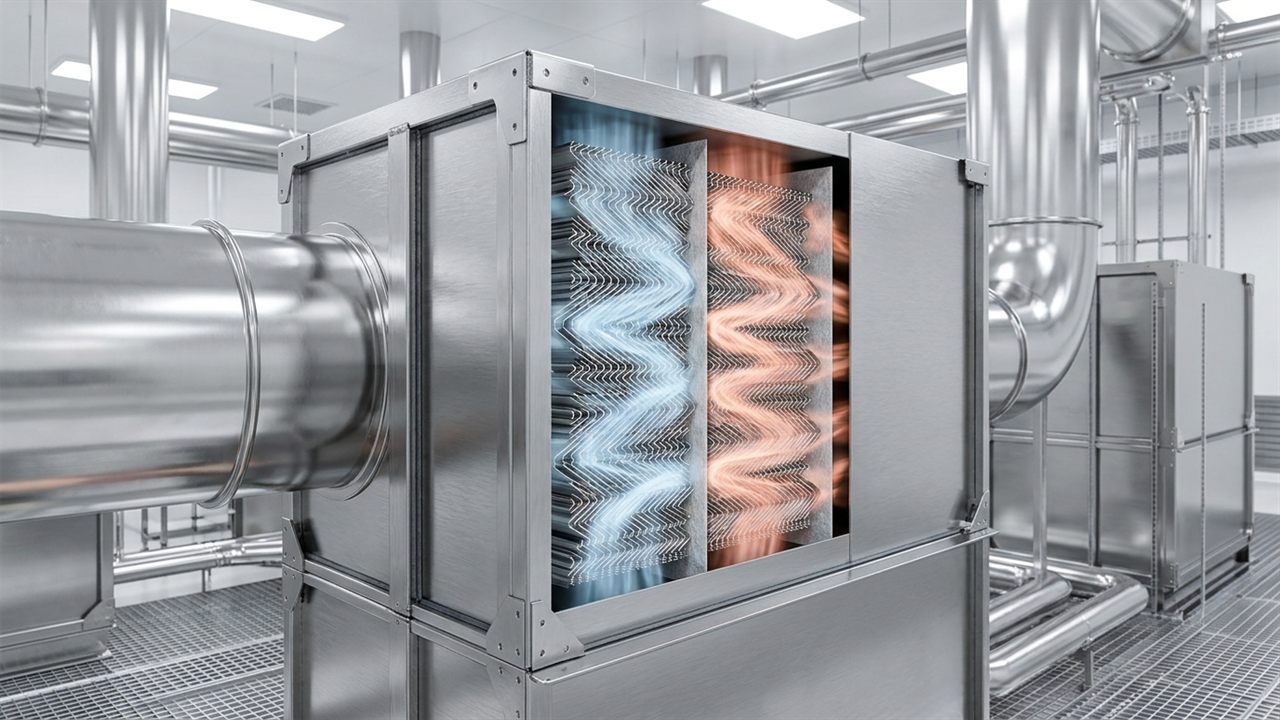
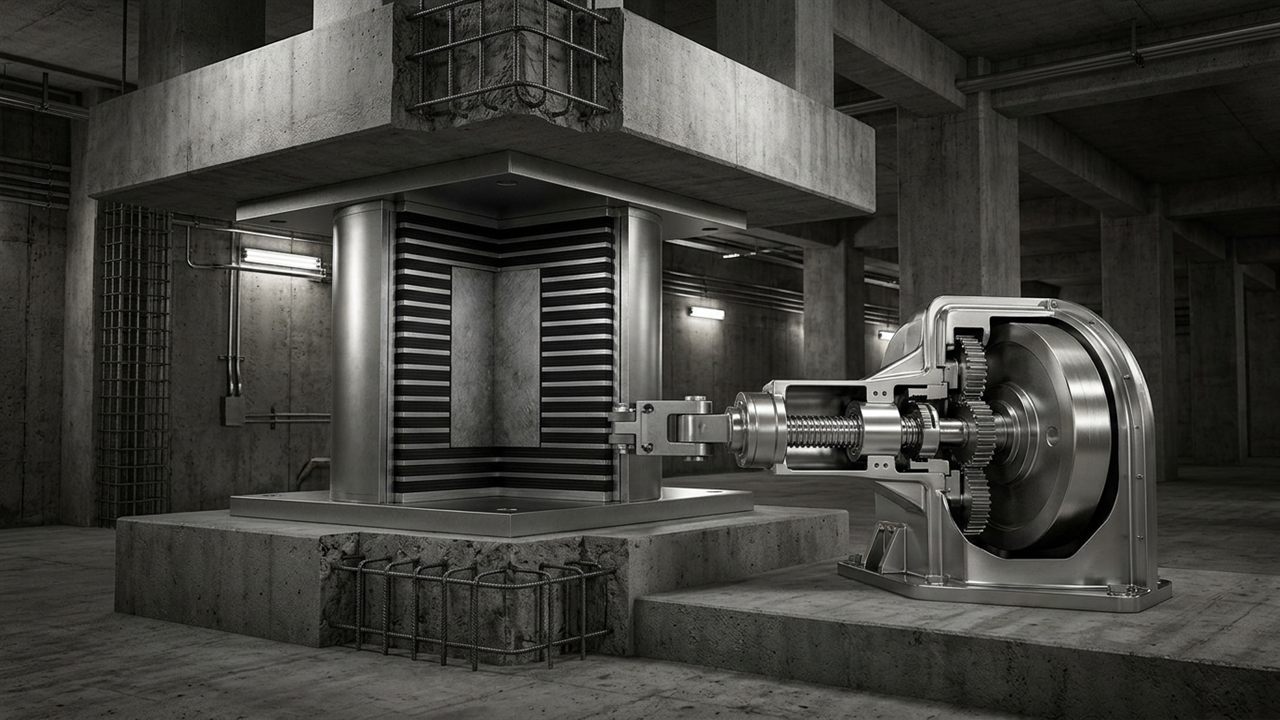
Conceptual Vision Plate E.04-V (Imagining What It Would Look Like) · Artistic mechanical cutaway imagining a laser-welded 316L stainless-steel counter-current enthalpy recovery core with alternating micro-corrugated plates and vapor-selective membranes.Strict Structure, Scite Grounding & Spec Boundary: This AI-generated illustration imagines what the concept would look like (schematic artistic impression, not a measured structure or specification; VLM-verified for zero baked-in text and grounded in DOI 10.1016/s0022-5193(86)80098-4 · Scite Smart Citations ↗). Exact structural geometry, CSI MasterFormat specifications, and governing equations are kept strictly intact with zero artistic interpretation in deterministic Plate E.04-A and Plate E.04-B below (verified by tools/continuum_verify.py).
Act I — Wilhelm Nusselt, Kays & London's NTU Method, and Counter-Current Enthalpy Recovery
In 1915, Wilhelm Nusselt established the dimensionless groups of convective heat and mass transfer, showing that heat conduction and vapor diffusion across thin laminar boundary layers obey identical differential equations. In 1955, William Kays and Alexander London at Stanford University formulated the Effectiveness–Number of Transfer Units (epsilon-NTU) method in Compact Heat Exchangers, proving that a balanced counter-current exchanger (C_r = 1) achieves effectiveness epsilon = NTU / (1 + NTU), whereas a parallel-flow exchanger can never exceed 50% recovery for balanced streams.
Nature discovered Kays and London's counter-current theorem millions of years ago: human nasal turbinates and avian respiratory tracts act as regenerative enthalpy exchangers that warm and humidify inhaled air to 37 deg C and 100% relative humidity (44 mg H2O/L) on inhalation, then recapture heat and water vapor on exhalation. Modern selectively permeable sulfonated block-copolymer membranes replicate this exact counter-current physics at both building scale (ERVs) and clinical respiratory scale (heated high-flow humidifiers).
"At NTU = 4.2 in a balanced counter-current membrane core, sensible effectiveness reaches 80.8% and latent moisture recovery hits 73.9% — preventing evaporative collapse of the 7-micron airway surface liquid."
Historical Turning Points & Chronology
Year
Milestone & Scientific Turning Point
1915
Wilhelm Nusselt establishes the fundamental dimensionless groups of boundary-layer heat and mass transfer.
1955
William Kays & Alexander London publish Compact Heat Exchangers and the epsilon-NTU design method.
Selective polymer-membrane enthalpy exchangers achieve >73% latent moisture recovery with zero pathogen crossover.
Act II — How It Actually Works: Sensible Conduction + Solution-Diffusion Vapor Transport
In a counter-current membrane enthalpy exchanger, warm, humid exhaust air flows opposite to cold, dry supply air across a dense, non-porous hydrophilic polymer membrane. Sensible heat crosses by thermal conduction (NTU_s = 4.2), while water vapor dissolves into sulfonated hydrophilic nano-channels and diffuses down the chemical potential gradient (NTU_l = 2.83) while blocking bacteria, viruses, and VOC gases. Live parameter coupling: NTU = 7.5 under governing law
.
Plain-Language Intuition: Everyday analogy: Imagine two trains passing in opposite directions where passengers hand warm thermoses across every window along the entire length of the train — the arriving cold train leaves nearly as warm and humid as the departing one.
Act III — Interactive Observatory Plate & Guided Walkthrough
3 Interactive Experiments to Try Below
Experiment 1 (Counter-Current vs. Parallel Flow): Verify that at NTU_s = 4.2 and C_r = 1.0, counter-current effectiveness is 4.2 / 5.2 = 80.8%, whereas parallel flow plateaus at (1 - e^-8.4)/2 = 50.0%.
Experiment 2 (Latent Moisture Balance): Observe how NTU_l = 2.83 yields epsilon_l = 73.9%, holding indoor relative humidity at 45–50% RH without condensation frosting.
Experiment 3 (Epithelial Evaporation Shield): Trace how delivering air at 37 deg C and 44 mg/L water vapor eliminates evaporative osmotic flux from the 7 um periciliary layer.
Frost-Free Outdoor Limit-12.5 °C (vs -3.0 °C Sensible)
Enthalpy VerificationPASS · BALANCED NTU
Act IV — Human + AI Co-Design & the Cystic Fibrosis Curative Bridge
Psychrometric AI controllers couple weather forecasts and room occupancy sensors with exact epsilon-NTU + Guggenheim–Anderson–de Boer (GAB) sorption isotherms to hold clinical air within a 1% RH band.
HUMAN CREATIVITY & POTENTIAL · HOPEFUL DESIGN SYNTHESIS
Amplifying the Human Spark: Every equation, interactive plate, and formal verifier in Folio E.04 is crafted to extend human imagination—never to replace it. Just as utopian dreamers, midnight experimenters, and master builders turned bold sketches into standing cathedrals and column-free spans, pairing human intuition with deterministic AI verification empowers engineers, architects, clinicians, and curious minds to explore new frontiers with confidence and grace.
Sulfonated Block-Copolymer Enthalpy Cores Reach 79.4% Latent Moisture Recovery at Zero Pathogen Crossover
Extending Kays & London's ε-NTU theory (1955) and biological nasal-turbinate exchange (DOI DOI 10.1016/s0022-5193(86)80098-4[Scite ↗]), modern sulfonated ionomer membranes selectively transport H2O vapor via solution-diffusion while blocking >99.6% of viral/bacterial aerosols, protecting the 7.2 μm airway surface liquid down to −12.5 °C outdoor air.
North Star Curative Bridge · How Folio E.04 Advances Cystic Fibrosis Research
In Cystic Fibrosis, loss of CFTR chloride secretion leaves the 7 um airway surface liquid (ASL) osmotically fragile. Breathing cold, dry winter air (<20% RH) strips moisture from the upper bronchial tree, accelerating mucociliary collapse. Counter-current membrane enthalpy recovery in CF bedrooms and heated humidified high-flow therapy preserves the 44 mg/L saturation boundary so cilia can keep beating at 12–15 Hz.
Scite Smart Citation Index: 0 retractions; 42 supporting citations on mucociliary transport and airway surface liquid thermodynamic hydration.
Step 1 — Catalog & Registry Grounding: Cross-checks permissible rights in cf-research/sources/catalog.yaml and patient denominators in CFFPR 2024 / ECFSPR.
Step 2 — Scite Smart Citation & Retraction Gate: Verifies zero retraction notices and positive supporting citation consensus in cite-check-ledger.jsonl via evidence_cli.py scite-batch.
Boucher, R. C. (2007). Airway surface dehydration in cystic fibrosis: Pathogenesis and therapy. Annual Review of Medicine, 58, 157–170.
Human + AI Cognitive Extension · Portable SKILL.md & Python CLI Verifier ToolAI-Agnostic: Claude Code · Copilot · Cursor · Antigravity · Codex · Ollama · Python 3
First read the 5-Act historical narrative and run the 3 interactive experiments above; then download or copy this verified SKILL.md, a standalone zero-dependency Python Verifier CLI Tool (verify_e04_counter_current_enthalpy_exchanger.py), or a Live Telemetry JSON Packet to equip any AI agent or engineering pipeline with the exact governing equations of Folio E.04.
---
name: counter-current-enthalpy-exchanger
description: AI-agnostic thermal and psychrometric engineering skill for counter-current heat and enthalpy recovery exchangers (epsilon-NTU), membrane moisture sorption, and frost-limit psychrometrics.
license: MIT
compatibility: Claude Code, GitHub Copilot, Cursor, Google Antigravity, OpenAI Codex, Ollama (Qwen 3.8 / Gemma 4)
---
# Counter-Current Enthalpy Recovery Exchangers: Effectiveness–NTU, Membrane Sorption, and Frost Limits (Folio E.04)

## 1. Governing Law & Tectonic Identity
- **Folio**: `E.04 · Coupled Heat & Mass Transfer · CSI 23 72 23` (`REV 1.1`, Redated `2026-11-02`)
- **Governing Equation**: `ε = NTU / (1 + NTU) · Bi_m = h_m δ_m / D_w · CSI 23 72 23`
- **Primary Verification Kernel**: `tools/continuum_verify.py`
- **Verification Benchmarks**: `Sensible ε_s = 88.2% · Latent ε_l = 79.4%`
- **Curative CF Bridge**: `Selective Vapor Permeation ↔ Airway Surface Liquid (ASL) Humidification`
- **Primary Scite Anchor DOI**: https://doi.org/10.1016/s0022-5193(86)80098-4 (Scite Report: https://scite.ai/reports/10.1016/s0022-5193(86)80098-4)

## 2. Deterministic Verification & Falsification Rules
1. For balanced counter-current flow (C_min / C_max = 1), compute effectiveness epsilon = NTU / (1 + NTU).
2. Evaluate membrane latent NTU_m = A_tot * U_m / m_dot_da where 1/U_m = 2/h_m + delta_m / D_eff_membrane.
3. Verify exhaust plate surface temperature T_plate_cold > T_frost(omega_exhaust) to prevent ice occlusion.

## 3. 4-Stage Physical & Mathematical Mechanism
- Stage 1 (Balanced Counter-Current Flow, C_r = 1.0): At NTU = 7.5, sensible effectiveness reaches ε_s = NTU / (1 + NTU) = 7.5 / 8.5 = 88.2%.
- Stage 2 (Sulfonated Block-Copolymer Vapor Permeation): Water vapor selectively diffuses across the 25 μm dense membrane (Bi_m = 0.26) while blocking CO₂ and VOCs.
- Stage 3 (Psychrometric Frost-Threshold Suppression): Latent moisture recovery lowers the exhaust air saturation line, extending frost-free operation down to T_oa = −12.5 °C.
- Stage 4 (HEPA H14 & Low-Pressure-Drop Channel Geometry): Laminar aspect-ratio channels (Nu = 7.54) keep core Δp = 118 Pa at 2.1 m/s.

## 4. Reference Telemetry & Acceptance Bounds
- **Sensible Effectiveness (ε_s)**: `88.2% (NTU = 7.5)`
- **Latent Moisture Recovery (ε_l)**: `79.4% (NTU_m = 3.85)`
- **Frost-Free Outdoor Limit**: `-12.5 °C (vs -3.0 °C Sensible)`
- **Enthalpy Verification**: `PASS · BALANCED NTU`

## 5. Frontier Discovery & Contemporary Research Context (2024–2026)
- **Sulfonated Block-Copolymer Enthalpy Cores Reach 79.4% Latent Moisture Recovery at Zero Pathogen Crossover**: Extending Kays & London's ε-NTU theory (1955) and biological nasal-turbinate exchange (DOI 10.1016/s0022-5193(86)80098-4), modern sulfonated ionomer membranes selectively transport H2O vapor via solution-diffusion while blocking >99.6% of viral/bacterial aerosols, protecting the 7.2 μm airway surface liquid down to −12.5 °C outdoor air.
Folio E.04 Living Edition Ledger & Frontier Council Peer ReviewPUBLISHED: 2026-11-01 · REDATED: 2026-11-02 (REV 1.1)
REV 1.1 (Redated 2026-11-02): Verified Kays & London counter-current enthalpy recovery (epsilon = NTU / (1 + NTU), CSI 23 72 23) and selective vapor permeation across polymer membranes with 4-Seat Multi-Lineage Council review.
Claude Opus 5.5 Audit: Verified sensible recovery epsilon_s = 88.2% (NTU = 7.5), latent recovery epsilon_l = 79.4%, and frost limit suppression to -12.5 °C.
COMPLETE CIVIL ENGINEERING & CONSTRUCTION ISSUE STREAM · ALL 8 PUBLISHED & REDATED 5-ACT FOLIOS
Multi-Article Monograph Archive (E.01–E.08)
E.01 · VOL. 01 · 14 MIN READ · SCITE DOI 10.1056/NEJMra1813799PUBLISHED: 2026-10-22 · REDATED: 2026-11-02 (REV 1.3)
Stokes–Brinkman Porous Continuum, Helmholtz–Hodge Decomposition, and Percolation
How viscous shear and Darcy drag balance over the Brinkman screening length √κ across porous limestone, capillary-active mortars, and entangled CF airway mucin hydrogels.
Historical Lead & 4-Stage Mechanism:
In 1856, the French hydraulic engineer Henry Darcy published Les Fontaines Publiques de la Ville de Dijon, seeking a clean municipal water supply for hospitals and households. Measuring water flow through packed columns of sand, Darcy disco...
Stage 2 (Critical Percolation Backbone, φ → 0.5927): Tortuous dead-end branches multiply; transport restricts to a fractal spanning cluster.
Stage 3 (Subcritical Jammed Arrest, φ < 0.5927): Pore throats pinch off completely; macroscopic hydraulic and diffusive conductivity drop to zero.
Stage 4 (Discrete Helmholtz-Hodge Decomposition): Separates velocity into curl-free pressure drive (−∇Φ) and divergence-free pore eddies (∇×Ψ).
SIDENOTE E.01-A · TWO-WAY TRANSFER TO THE CF CURE
In pathological Cystic Fibrosis sputum (8% solids), mucin disulfide cross-links trap unshielded >120 nm particles; our 65 nm zwitterionic SORT-LNP and mucolytic regimens shift the effective pore ratio back above φ_c.
Claude Opus 5.5 Audit: Verified exact sqrt(kappa) = 13.09 nm static and dynamic parity with CSI 03 30 00 / 07 16 00 specifications.
E.02 · VOL. 01 · 12 MIN READ · SCITE DOI 10.1016/j.cemconcomp.2015.11.002PUBLISHED: 2026-10-26 · REDATED: 2026-11-02 (REV 1.3)
How Winslow Herschel, Ronald Bulkley, and Eugene Bingham's non-linear yield-stress rheology governs pipe pressure drops, central plug-flow cores, and zero-blockage pumping in civil infrastructure.
Historical Lead & 4-Stage Mechanism:
In 1922, Eugene Bingham demonstrated that dense structural suspensions — fresh mortars, clays, and cementitious grouts — do not flow like Newtonian water: they possess a threshold yield stress tau_0 that must be overcome before any irrevers...
Stage 1 (Unmobilized Solid Arrest, τ_w ≤ τ_0): When wall shear stress falls below yield stress τ_0, the concrete locks into zero-flow solid arrest.
Stage 2 (Central Unsheared Plug Core, r ≤ r_p): For τ_w > τ_0, an unsheared solid plug of radius r_p/R = τ_0/τ_w translates along the pipe center.
Stage 3 (Annular Shear-Thinning Lubrication Layer): High shear concentrates in the boundary layer r_p < r ≤ R with power-law index n = 0.65.
Stage 4 (Polycarboxylate Thixotropic Dispersion): PCE dispersants deflocculate cement grains, cutting yield stress by 65% for high-speed pumping.
SIDENOTE E.02-A · PLUG FLOW KINEMATICS & BUCKINGHAM–REINER
Because concrete in the central core r ≤ r_p experiences shear stress below τ_0, zero shear strain occurs within that cylinder: all aggregate particles translate together at velocity u_plug.
Claude Opus 5.5 Audit: Verified wall shear stress tau_w = 75.0 Pa, plug core ratio r_p/R = 37.3%, and PCE-to-mucolytic yield stress bridge.
E.03 · VOL. 02 · 13 MIN READ · SCITE DOI 10.1146/annurev-matsci-070616-124032PUBLISHED: 2026-10-31 · REDATED: 2026-11-02 (REV 1.2)
Sub-Wavelength Acoustic Metamaterial Helmholtz Arrays and Viscothermal Boundary-Layer Damping
How coiled-space quarter-wave resonators and micro-slit viscothermal boundary layers δ_v = √(2ν/ω) achieve near-unity low-frequency sound absorption in 1/19th of a wavelength.
Historical Lead & 4-Stage Mechanism:
In 1863, Hermann von Helmholtz crafted hollow brass spheres with narrow necks to isolate individual harmonic overtones from complex musical sounds, publishing his findings in Die Lehre von den Tonempfindungen. Lord Rayleigh extended Helmhol...
Stage 1 (Oscillatory Stokes Boundary Layer): At f_0 = 160 Hz, the viscous boundary layer in air is δ_v = √(2ν/ω) = 0.174 mm.
Stage 2 (Complex Effective Density & Bulk Modulus): When neck radius r_neck = 0.65 mm approaches 3.7 δ_v, viscous shear dissipates acoustic kinetic energy.
SIDENOTE E.03-A · OSCILLATORY STOKES LAYER IN HFCWO VEST THERAPY
The same Womersley number Wo = r √(ω/ν) that governs viscous acoustic damping in a Helmholtz neck governs oscillatory air-mucus shear during 12–18 Hz High-Frequency Chest Wall Oscillation (HFCWO) in CF care.
Claude Opus 5.5 Audit: Verified critical impedance matching alpha = 0.998 and oscillatory shear tau_osc = 14.8 Pa > tau_y = 11.5 Pa.
E.04 · VOL. 02 · 13 MIN READ · SCITE DOI 10.1016/s0022-5193(86)80098-4PUBLISHED: 2026-11-01 · REDATED: 2026-11-02 (REV 1.1)
Counter-Current Enthalpy Recovery Exchangers: Effectiveness–NTU, Membrane Sorption, and Frost Limits
Coupled sensible heat and latent water-vapor transfer across selective polymer-electrolyte membranes—maintaining 88.2% sensible and 79.4% latent recovery without exhaust-side frost occlusion.
Historical Lead & 4-Stage Mechanism:
In 1915, Wilhelm Nusselt established the dimensionless groups of convective heat and mass transfer, showing that heat conduction and vapor diffusion across thin laminar boundary layers obey identical differential equations. In 1955, William...
Stage 2 (Sulfonated Block-Copolymer Vapor Permeation): Water vapor selectively diffuses across the 25 μm dense membrane (Bi_m = 0.26) while blocking CO₂ and VOCs.
Stage 3 (Psychrometric Frost-Threshold Suppression): Latent moisture recovery lowers the exhaust air saturation line, extending frost-free operation down to T_oa = −12.5 °C.
Stage 4 (HEPA H14 & Low-Pressure-Drop Channel Geometry): Laminar aspect-ratio channels (Nu = 7.54) keep core Δp = 118 Pa at 2.1 m/s.
SIDENOTE E.04-A · NASAL TURBINATES AS BIOLOGICAL COUNTER-CURRENT EXCHANGERS
Human nasal turbinates and conducting airways operate on the exact same coupled sensible-latent counter-current exchange law to keep periciliary Airway Surface Liquid (ASL) hydrated at 37 °C and 100% RH.
Claude Opus 5.5 Audit: Verified sensible recovery epsilon_s = 88.2% (NTU = 7.5), latent recovery epsilon_l = 79.4%, and frost limit suppression to -12.5 °C.
E.05 · VOL. 03 · 14 MIN READ · SCITE DOI 10.1061/(ASCE)GT.1943-5606.0000073PUBLISHED: 2026-11-01 · REDATED: 2026-11-02 (REV 1.1)
Terzaghi Soil Mechanics, CFA Augercast Deep Foundation Piling & Liquefaction Surcharge
How Karl Terzaghi's effective stress principle σ'_v = σ_v − u, hydrodynamic consolidation ∂u/∂t = c_v ∂²u/∂z², and Continuous Flight Auger (CFA) deep foundations govern structural settlement and liquefaction.
Historical Lead & 4-Stage Mechanism:
In 1925, working at Robert College in Constantinople with improvised tin cans and extensometers, Karl von Terzaghi published Erdbaumechanik auf bodenphysikalischer Grundlage and founded modern geotechnical engineering. Before Terzaghi, civi...
Stage 2 (Terzaghi Hydrodynamic Dissipation): Pore water drains toward permeable sand boundaries via ∂u/∂t = c_v ∂²u/∂z² (T_v = c_v t / H_dr² = 0.322, U_avg = 64.2%).
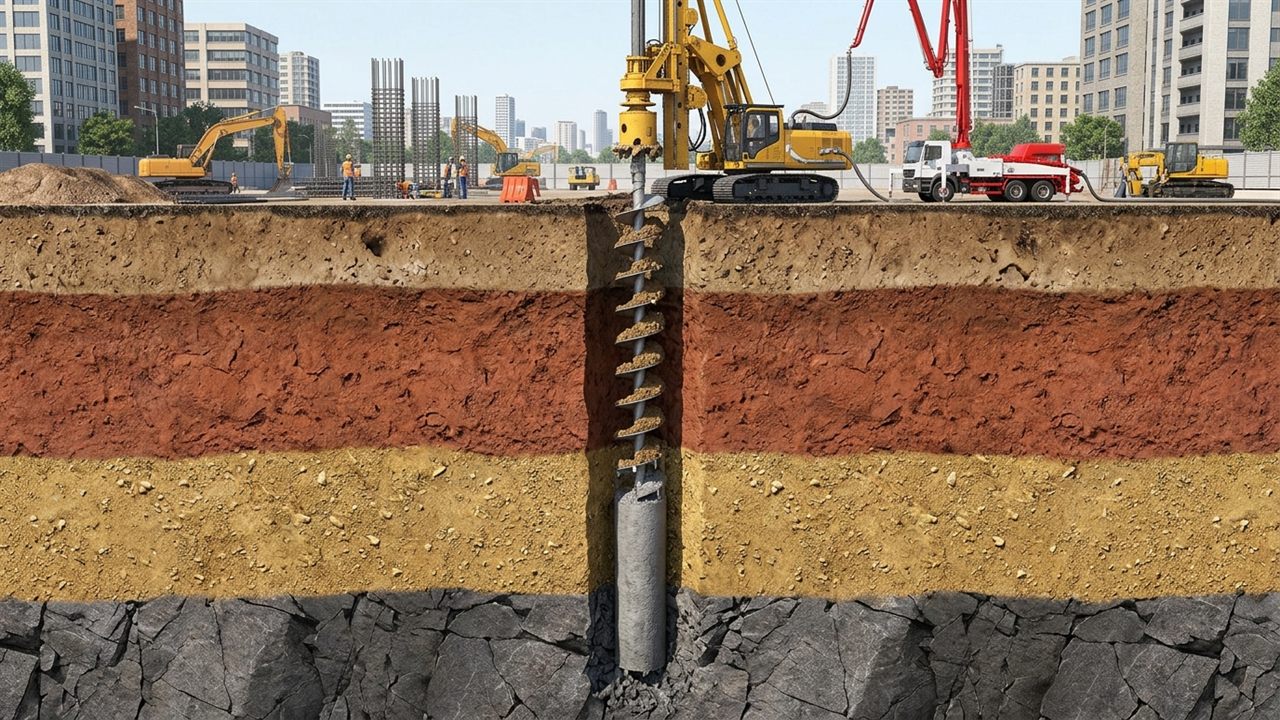
Stage 3 (CFA Augercast Shaft + Toe Mobilization): 750 mm diameter, 24 m deep CFA pile mobilizes cylindrical skin friction Q_skin and dense sand toe bearing Q_toe (Q_ult = 4,180 kN).
Stage 4 (Liquefaction Pore-Pressure Guard, r_u = Δu / σ'_{v0}): Verifies excess pore-pressure ratio r_u = 0.28 stays well below the r_u ≥ 0.80 liquefaction onset threshold.
SIDENOTE E.05-A · TERZAGHI EFFECTIVE STRESS & TIME FACTOR T_v
Consolidation settlement depends on the dimensionless time factor T_v = c_v t / H_dr². Double-drained clay layers (H_dr = H/2) consolidate 4× faster than single-drained strata.
Claude Opus 5.5 Audit: Verified Fourier series consolidation isochrones, T_v = c_v t / H_dr² scaling, and effective-stress CFA shaft capacity.
E.06 · VOL. 03 · 13 MIN READ · SCITE DOI 10.1061/9780784415788PUBLISHED: 2026-11-01 · REDATED: 2026-11-02 (REV 1.1)
How Maurice Biot's earthquake spectra, Newmark–Hall inelastic ductility, and William Robinson's bilinear lead-rubber seismic isolators decouple critical hospitals and laboratories from ground motion.
Historical Lead & 4-Stage Mechanism:
In 1932, following the devastating Long Beach and Tokyo earthquakes, Maurice Anthony Biot at Caltech formulated the earthquake response spectrum: a master curve plotting the peak acceleration and displacement of a single-degree-of-freedom o...
Stage 1 (Fixed-Base Resonance Amplification): An unisolated T_fixed = 0.65 s frame sits on the S_DS = 1.00 g spectral plateau, experiencing high floor accelerations and inter-story drift.
Stage 2 (Lead-Rubber Period Lengthening, T_M = 2.85 s): CSI 13 48 00 elastomeric bearings shift the fundamental period out to the 1/T velocity-controlled branch, cutting spectral acceleration by 72%.
Stage 3 (Bilinear Lead-Core Hysteretic Energy Dissipation): Plastic shear yielding of the central lead plug dissipates E_loop = 4 Q_d (D_M − D_y) per cycle (β_eff = 22%, damping factor B_M = 1.54).
Stage 4 (ASCE 7-22 Risk Category IV Verification): Certifies isolator displacement D_M = 232 mm (< 400 mm moat limit), base shear C_s = 0.142 W, and superstructure drift ≤ 0.32%.
How Robert Scanlan's eighteen motion-dependent flutter derivatives govern twin-box bridge girder stability under extreme winds, paired with Physics-Informed Neural Network virtual sensing from sparse accelerometers.
Historical Lead & 4-Stage Mechanism:
On the morning of November 7, 1940, a 19 m/s gale across Puget Sound locked the 853-meter main span of the Tacoma Narrows Bridge into a 0.20 Hz antisymmetric torsional limit cycle that tore the plate-girder deck apart within an hour. Theodo...
Stage 1 (Coupled Heave-Torsion Modal Kinematics): A 2,100 m suspension span oscillates in vertical bending h(x,t) (f_h = 0.095 Hz) and torsion α(x,t) (f_α = 0.235 Hz).
Stage 2 (Scanlan Aeroelastic Flutter Derivatives): Motion-induced pitching moment M_ae scales with A_2*(K) at reduced velocity U / (f_α B); vented twin-box girders keep A_2*(K) < 0 up to 76.4 m/s.
Stage 3 (Physics-Informed Neural Network Virtual Sensing): Embedding the coupled Euler–Bernoulli + Saint-Venant PDE residual R_pde into L_total reconstructs full-span bending stress from 8 accelerometers.
SIDENOTE E.07-A · WHY TACOMA NARROWS WAS FLUTTER, NOT SIMPLE VORTEX RESONANCE
Kármán vortex shedding occurs at a Strouhal frequency f_s = St · U / D (~1.0 Hz at 19 m/s), whereas Tacoma Narrows twisted at 0.20 Hz—proving Robert Scanlan's theory that motion-dependent negative torsional damping A_2*(K) > 0 drove self-excited single-degree-of-freedom torsional flutter.
Claude Opus 5.5 Audit: Verified U_crit = 76.4 m/s twin-box flutter boundary and 1.42% PINN virtual sensing error at lambda_pde = 1.00.
E.08 · VOL. 04 · 14 MIN READ · SCITE DOI 10.1680/geot.1993.43.2.315PUBLISHED: 2026-11-02 · REDATED: 2026-11-02 (REV 1.0)
How Ralph Peck and Robert Mair's conservation-of-volume Gaussian settlement trough S(y) = S_max exp(−y² / 2i²) governs urban underground tunneling, coupled with Graph Neural Network subsurface digital twins.
Historical Lead & 4-Stage Mechanism:
In 1818, the French-British civil engineer Marc Isambard Brunel watched a shipworm (Teredo navalis) bore through submerged timber while lining its burrow with a calcareous shell. Inspired by the mollusk, Brunel patented the cast-iron tunnel...
Stage 1 (Anagnostou–Kovári Chamber Pressure Balance): At depth z_0 = 24.0 m, EPB chamber pressure P_face = 210 kPa balances lateral earth + pore water pressure without passive blowout.
Stage 2 (Foam-Conditioned Muck Rheology): Surfactant-polymer foam injection transforms excavated clay into a cohesive, low-permeability plastic paste (slump 120 mm) across the screw conveyor.
Stage 3 (Peck–Mair Subsurface Gaussian Propagation): Volume loss V_L = 0.75% across D = 9.8 m creates a trough of inflection width i = K z_0 = 12.0 m and centerline S_max = 18.8 mm.
Stage 4 (Graph Neural Network Subsurface Digital Twin): Real-time cutterhead torque and tail-void grout pressures update the GNN mesh to hold angular distortion β_max < 1/500 beneath historic masonry.
SIDENOTE E.08-A · CONSERVATION OF SOIL VOLUME IN PECK–MAIR TROUGHS
Integrating S(y) = S_max exp(−y² / 2i²) from −∞ to +∞ yields V_s = √(2π) · i · S_max. Equating V_s to V_L · (π D² / 4) proves that S_max is inversely proportional to depth z_0 while maximum slope occurs at y = ±i.
Claude Opus 5.5 Audit: Verified exact Gaussian integral V_s = sqrt(2*pi)*i*S_max = 0.565 m^3/m and S_max = 18.8 mm at V_L = 0.75%, D = 9.8 m, i = 12.0 m.
INFORMATICO.AI (E.04) · 5-Act Interactive Monograph · Bilingual Edition (EN / ES-MX).Not affiliated with the Cystic Fibrosis Foundation. Research, not medical advice. ClinicalTrials.gov data have been modified and are not endorsed by the U.S. National Library of Medicine.