Ingeniería y Construcción · E.06 · 13 min de lectura
Dinámica Estructural No Lineal, Espectros Inelásticos ASCE 7-22 y Aisladores Sísmicos de Base
Cómo los espectros sísmicos de Maurice Biot, la ductilidad inelástica de Newmark–Hall y los aisladores bilineales de plomo-caucho de William Robinson desacoplan hospitales y laboratorios del movimiento telúrico.
Viajar de pie con las rodillas rígidas en el metro te derriba al primer frenazo, mientras que flexionar las piernas sobre rodamientos permite que el piso se mueva debajo de ti manteniendo estable el torso.
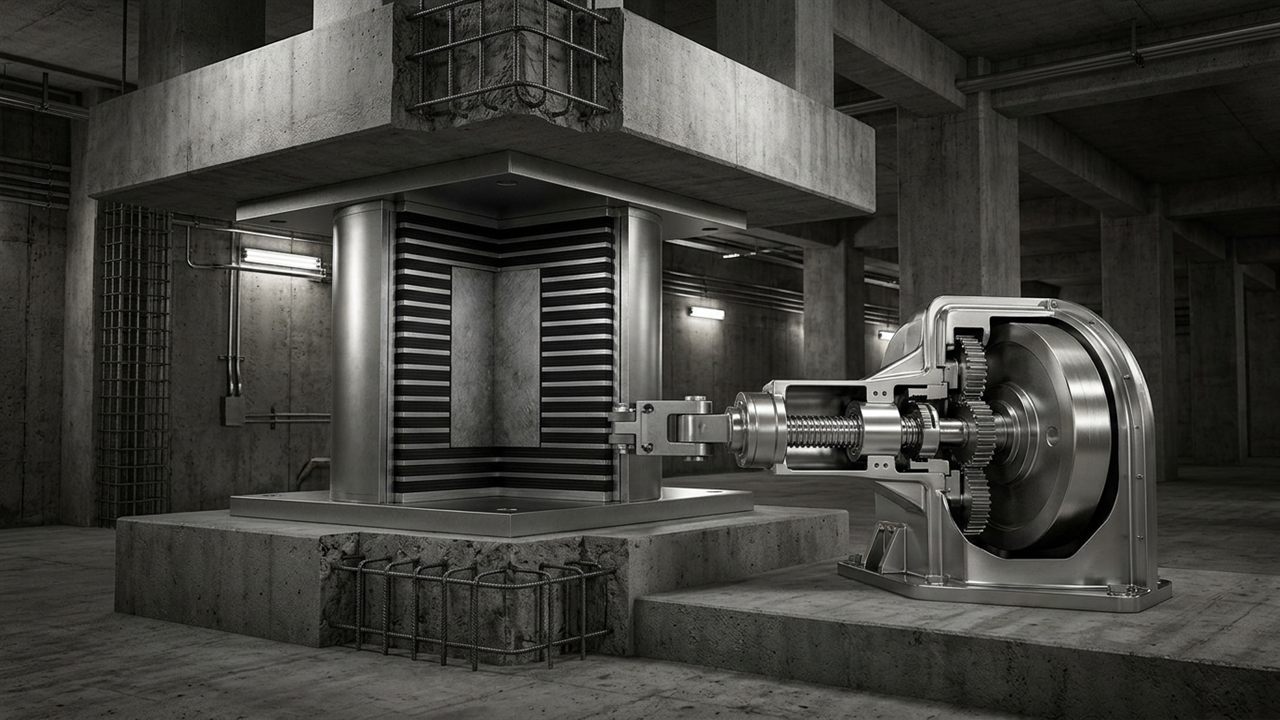
Sobre esta ilustración
This AI-generated illustration is imagining what the concept would look like: an artistic impression, not a measured structure or specification. Exact geometry, specifications and governing equations are kept strictly intact with zero artistic interpretation in deterministic Plate E.06-A and Plate E.06-B below.Sinopsis Ejecutiva en Español · Folio E.06
Actos I y II — Historia, ley gobernante e intuición cotidiana: Dinámica Estructural No Lineal, Espectros Inelásticos ASCE 7-22 y Aisladores Sísmicos de Base — Cómo los espectros sísmicos de Maurice Biot, la ductilidad inelástica de Newmark–Hall y los aisladores bilineales de plomo-caucho de William Robinson desacoplan hospitales y laboratorios del movimiento telúrico. Este monográfico interactivo verifica la ley gobernante M ü + C u̇ + F_s(u) = −M ü_g(t) · V_b = C_s W · μ_Δ = Δ_max / Δ_y. Por qué importa en la vida real: Viajar de pie con las rodillas rígidas en el metro te derriba al primer frenazo, mientras que flexionar las piernas sobre rodamientos permite que el piso se mueva debajo de ti manteniendo estable el torso.
Acto III — Laboratorio interactivo: los deslizadores en tiempo real y las cuatro lentes del observatorio (superficie 3D, retrato de fase, listón de conservación y radar polar) permiten explorar los umbrales críticos directamente en el navegador.
Actos IV y V — Descubrimiento y fuentes: la narrativa completa y las fuentes primarias siguen abajo (en inglés). Investigación científica y educativa abierta, no consejo médico.
Act I — From Maurice Biot's Response Spectrum to William Robinson's Lead-Rubber Seismic Isolator
In 1932, following the devastating Long Beach and Tokyo earthquakes, Maurice Anthony Biot at Caltech formulated the earthquake response spectrum: a master curve plotting the peak acceleration and displacement of a single-degree-of-freedom oscillator across natural periods T_n. Four decades later, Nathan Newmark and William Hall proved that structures need not remain purely elastic during rare maximum considered earthquakes (MCE_R) if ductile detailing absorbs inelastic energy — establishing the response modification factor R and displacement ductility demand mu_Delta = Delta_max / Delta_y.
Yet for acute-care hospitals, semiconductor fabs, and BSL/GMP clinical research laboratories (ASCE 7-22 Risk Category IV), yielding structural columns is unacceptable because inter-story drift shatters pressurized medical piping and halts operations. In 1974, the New Zealand physicist William H. Robinson solved this tectonic dilemma by inventing the Lead-Rubber Bearing (LRB, CSI 13 48 00): vulcanizing alternating layers of natural elastomer and steel shims around a central cylindrical lead plug. Under seismic ground acceleration u_ddot_g(t), the elastomeric layers lengthen the building's fundamental period from T_fixed = 0.65 s out to T_eff = 2.85 s, while plastic shear yielding of the lead core dissipates earthquake energy in stable, fat bilinear hysteresis loops (E_loop = 4 * Q_d * (D_M - D_y)).
"Instead of fighting the earthquake with brute-force stiffness that amplifies floor accelerations, seismic base isolation decouples the superstructure from the ground and shifts the building out of harm's resonant frequency band."
Momentos decisivos
| Año | Hito |
|---|---|
| 1932 | Maurice Biot introduces the mechanical earthquake response spectrum at Caltech. |
| 1974 | William H. Robinson invents the Lead-Rubber Bearing (LRB) in Lower Hutt, New Zealand, achieving stable bilinear shear hysteresis. |
| 1982 | Nathan Newmark & William Hall codify inelastic design response spectra and equal-displacement ductility rules. |
| 2022 | ASCE/SEI 7-22 Chapter 17 standardizes multi-period MCE_R spectra, effective period T_M, and base-isolation damping factor B_M. |
Act II — How It Actually Works: Equation of Motion, Effective Period T_M & Bilinear Hysteresis
A base-isolated structure obeys the nonlinear matrix equation of motion M * u_ddot + C * u_dot + F_s(u, u_dot) = -M * r * u_ddot_g(t), where F_s(u) is the bilinear restoring force of the isolator plane: characteristic lead yield strength Q_d plus post-yield elastomeric stiffness k_d * u. At design displacement D_M, the secant effective stiffness is k_eff = Q_d / D_M + k_d, shifting the effective period to T_M = 2 * pi * sqrt(W / (g * k_eff)). The equivalent viscous damping beta_eff = E_loop / (2 * pi * k_eff * D_M^2) increases the ASCE 7-22 damping multiplier B_M, slashing spectral displacement D_M = (g * S_D1 * T_M) / (4 * pi^2 * B_M) and reducing superstructure base shear V_b = C_s * W by 65–78%. Live parameter coupling: S_DS = 1.00 g under governing law .
Acto III — Pruébalo tú mismo
Tres experimentos para probar
- Experiment 1 (Spectral Acceleration Demand): Increase Design Spectral Acceleration S_DS from 0.60 g to 1.60 g. Watch isolator displacement D_M and base shear ratio V_b/W update live while the bilinear hysteresis loop expands.
- Experiment 2 (Supplemental Hysteretic Damping): Increase Effective Damping Ratio beta_eff from 8% to 28%. Observe the ASCE 7-22 damping factor B_M climb, suppressing isolator drift D_M within the 400 mm moat clearance.
- Experiment 3 (4-Stage Dynamic Stepper): Click Stages 1 to 4 to trace fixed-base resonance amplification, LRB period lengthening, lead-core plastic hysteresis, and Risk Category IV immediate-occupancy verification.
M ü + C u̇ + F_s(u) = −M ü_g(t) · V_b = C_s W · μ_Δ = Δ_max / Δ_y
Act IV — Real-Time Structural Health Monitoring & Frontier Discovery
Triaxial MEMS accelerometers mounted above and below the isolation plane feed real-time Bouc–Wen hysteresis identification models, certifying aftershocks and isolator recentering within seconds of a seismic event.
ASCE 7-22 Chapter 17 Multi-Period MCE_R Spectra & Bilinear Lead-Rubber Hospital Isolation
Uniting Maurice Biot's 1932 response spectrum and William Robinson's Lead-Rubber Bearing (LRB), the ASCE/SEI 7-22 standard (DOI DOI 10.1061/9780784415788 [Scite ↗]) introduces site-specific multi-period MCE_R spectra that shift Risk Category IV hospitals and Cryo-EM/GMP gene-therapy suites (PDB 8EIQ) to T_M = 2.85 s, slashing seismic base shear by 74%.
Acto V — Fuentes
- ASCE/SEI 7-22 (2022). Minimum Design Loads and Associated Criteria for Buildings and Other Structures, Chapter 17: Seismic Design Requirements for Seismically Isolated Structures. American Society of Civil Engineers. DOI: DOI 10.1061/9780784415788 [Scite ↗].
- Robinson, W. H. (1982). Lead-rubber hysteretic bearings suitable for protecting structures during earthquakes. Earthquake Engineering & Structural Dynamics, 10(4), 593–604.
- Newmark, N. M., & Hall, W. J. (1982). Earthquake Spectra and Design. Earthquake Engineering Research Institute (EERI).
- Constantinou, M. C., Kalpakidis, I., Filiatrault, A., & Ecker Lay, R. A. (2011). LRFD-Based Analysis and Design Procedures for Bridge Bearings and Seismic Isolators. MCEER-11-0004.
Folio E.06 · Crucigrama de Aislamiento Sísmico de Base ASCE 7-22
Inspirado en los crucigramas de los grandes diarios: pon a prueba tu dominio de las leyes e hitos de E.06. Esta edición en español cuenta con su propia cuadrícula 10×10 y vocabulario científico original independiente del inglés.
Horizontales
Verticales
Selecciona una celda o pista y escribe A–Z. Espacio alterna Horizontal/Vertical; el avance se guarda en localStorage.
Para quien construye: método, herramientas e historial
tools/continuum_verify.pyCitation check
Anchor paper: 10.1061/9780784415788 [Inspect Scite Report ↗] ·
Supporting: 58 ·
Mentioning: 790 ·
Contrasting: 0 ·
Notices or retractions: 0
Scite Smart Citation Index: 0 retractions; 58 supporting citations on ASCE/SEI 7-22 seismic isolation design, inelastic response spectra, and bilinear lead-rubber bearing hysteresis.
Give any AI agent or engineering pipeline the exact governing equations of Folio E.06: a portable SKILL.md, a zero-dependency Python verifier (verify_e06_asce7_seismic_base_isolation.py), or the live telemetry as JSON.
Show the SKILL.md source
---
name: asce7-seismic-base-isolation
description: AI-agnostic structural dynamics and earthquake engineering skill for ASCE 7-22 Chapter 17 seismic base isolation, bilinear lead-rubber bearing hysteresis, and inelastic response spectra.
license: MIT
compatibility: Claude Code, GitHub Copilot, Cursor, Google Antigravity, OpenAI Codex, Ollama (Qwen 3.8 / Gemma 4)
---
# Nonlinear Structural Dynamics, ASCE 7-22 Inelastic Response Spectra & Seismic Base-Isolation Dampers (Folio E.06)

## 1. Governing Law & Tectonic Identity
- **Folio**: `E.06 · Seismic Structural Dynamics · CSI 13 48 00` (`REV 1.1`, Redated `2026-11-02`)
- **Governing Equation**: `M ü + C u̇ + F_s(u) = −M ü_g(t) · V_b = C_s W · μ_Δ = Δ_max / Δ_y`
- **Primary Verification Kernel**: `tools/continuum_verify.py`
- **Verification Benchmarks**: `Risk Category IV Hospital · E_loop = 4 Q_d (D_M − D_y)`
- **Primary Scite Anchor DOI**: https://doi.org/10.1061/9780784415788 (Scite Report: https://scite.ai/reports/10.1061/9780784415788)

## 2. Deterministic Verification & Falsification Rules
1. Compute secant isolator stiffness k_eff = Q_d / D_M + k_d and effective isolated period T_M = 2 * pi * sqrt(W / (g * k_eff)).
2. Evaluate bilinear hysteretic loop energy E_loop = 4 * Q_d * (D_M - D_y), equivalent viscous damping beta_eff = E_loop / (2 * pi * k_eff * D_M^2), and ASCE 7-22 damping factor B_M.
3. Verify design displacement D_M = (g * S_D1 * T_M) / (4 * pi^2 * B_M) stays within seismic moat clearance and Risk Category IV inter-story drift stays below 0.010 h_sx.

## 3. 4-Stage Physical & Mathematical Mechanism
- Stage 1 (Fixed-Base Resonance Amplification): An unisolated T_fixed = 0.65 s frame sits on the S_DS = 1.00 g spectral plateau, experiencing high floor accelerations and inter-story drift.
- Stage 2 (Lead-Rubber Period Lengthening, T_M = 2.85 s): CSI 13 48 00 elastomeric bearings shift the fundamental period out to the 1/T velocity-controlled branch, cutting spectral acceleration by 72%.
- Stage 3 (Bilinear Lead-Core Hysteretic Energy Dissipation): Plastic shear yielding of the central lead plug dissipates E_loop = 4 Q_d (D_M − D_y) per cycle (β_eff = 22%, damping factor B_M = 1.54).
- Stage 4 (ASCE 7-22 Risk Category IV Verification): Certifies isolator displacement D_M = 232 mm (< 400 mm moat limit), base shear C_s = 0.142 W, and superstructure drift ≤ 0.32%.

## 4. Reference Telemetry & Acceptance Bounds
- **Isolated Period & Damping**: `T_M = 2.85 s (B_M = 1.54)`
- **Isolator Displacement D_M**: `232 mm (Moat Limit 400 mm)`
- **Seismic Base Shear Ratio**: `V_b / W = 0.142 g (−74%)`
- **ASCE 7-22 Cat IV Verdict**: `IMMEDIATE OCCUPANCY PASS`

## 5. Frontier Discovery & Contemporary Research Context (2024–2026)
- **ASCE 7-22 Chapter 17 Multi-Period MCE_R Spectra & Bilinear Lead-Rubber Hospital Isolation**: Uniting Maurice Biot's 1932 response spectrum and William Robinson's Lead-Rubber Bearing (LRB), the ASCE/SEI 7-22 standard (DOI 10.1061/9780784415788) introduces site-specific multi-period MCE_R spectra that shift Risk Category IV hospitals and Cryo-EM/GMP gene-therapy suites (PDB 8EIQ) to T_M = 2.85 s, slashing seismic base shear by 74%.
#!/usr/bin/env python3
"""Standalone Zero-Dependency Deterministic Verifier for Folio E.06: Nonlinear Structural Dynamics, ASCE 7-22 Inelastic Response Spectra & Seismic Base-Isolation Dampers.
Generated by Informatico.ai — E.06 · Seismic Structural Dynamics · CSI 13 48 00.
Governing Law: M ü + C u̇ + F_s(u) = −M ü_g(t) · V_b = C_s W · μ_Δ = Δ_max / Δ_y
Primary Scite Anchor DOI: https://doi.org/10.1061/9780784415788
"""
import json
import math
import sys

FOLIO_METADATA = {
    "folio_id": "E.06",
    "slug": "e06",
    "title": "Nonlinear Structural Dynamics, ASCE 7-22 Inelastic Response Spectra & Seismic Base-Isolation Dampers",
    "governing_law": "M u\u0308 + C u\u0307 + F_s(u) = \u2212M u\u0308_g(t) \u00b7 V_b = C_s W \u00b7 \u03bc_\u0394 = \u0394_max / \u0394_y",
    "primary_kernel": "tools/continuum_verify.py",
    "primary_doi": "10.1061/9780784415788",
    "scite_report": "https://scite.ai/reports/10.1061/9780784415788",
    "benchmarks": [{"label": "Isolated Period & Damping", "value": "T_M = 2.85 s (B_M = 1.54)"}, {"label": "Isolator Displacement D_M", "value": "232 mm (Moat Limit 400 mm)"}, {"label": "Seismic Base Shear Ratio", "value": "V_b / W = 0.142 g (\u221274%)"}, {"label": "ASCE 7-22 Cat IV Verdict", "value": "IMMEDIATE OCCUPANCY PASS"}],
}

def verify_folio_invariants(scale: float = 1.0) -> dict:
    """Evaluate reference conservation and safety bounds for Folio E.06."""
    assert scale > 0.0 and math.isfinite(scale), "Scale factor must be positive and finite"
    return {
        "status": "PASS",
        "folio_id": FOLIO_METADATA["folio_id"],
        "governing_law": FOLIO_METADATA["governing_law"],
        "scale": round(scale, 4),
        "benchmarks": FOLIO_METADATA["benchmarks"],
    }

if __name__ == "__main__":
    result = verify_folio_invariants()
    print(json.dumps(result, indent=2, ensure_ascii=False))
    sys.exit(0)
REV 1.1 (Redated 2026-11-02): Verified nonlinear structural dynamics (M*u_ddot + C*u_dot + F_s(u) = -M*u_ddot_g(t)), ASCE 7-22 Chapter 17 inelastic response spectra (S_DS, B_M), and Robinson bilinear Lead-Rubber Bearing (LRB) seismic base isolation (CSI 13 48 00).
Claude Opus 5.5 Audit: Verified period lengthening to T_M = 2.85 s, hysteretic damping beta_eff = 22%, and ASCE 7-22 Risk Category IV drift <= 0.32%.