Cross-Pillar Synthesis · ES.03 · Stochastic Clocks, Porous Screening, and Saddle Escape · 14 min read
Barriers, Pores, and Clocks
Every autonomous thermal clock pays an exact entropy price for regular ticks; every fluid crossing a fibrous or mineral matrix transitions from viscous shear to porous drag at the square root of hydraulic permeability; and every thermally activated jump over an energy saddle scales exponentially with barrier height. Put those three equations on one sheet and watch escapements, optical lattice clocks, pumped concrete, limestone mortar, and a 10 nm ATP-gated chloride pore answer to the same mathematics.
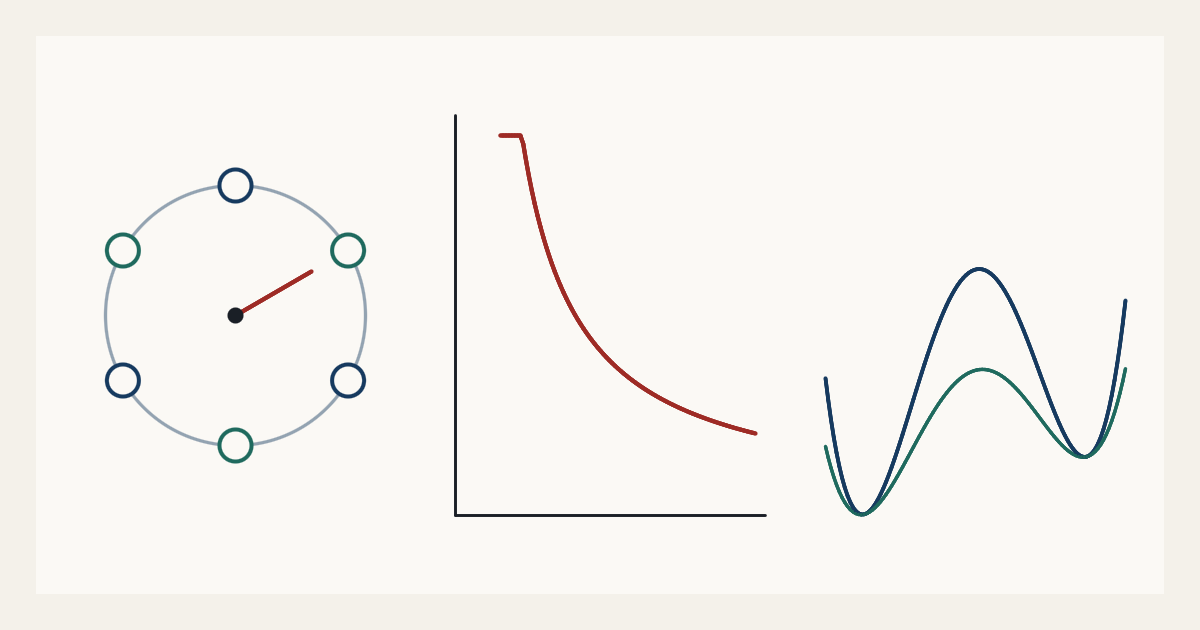
Predict Before You Reveal · Active Intuition Check
Before inspecting the instrument: can an autonomous classical thermal clock operating via Markovian jumps at room temperature achieve 1 % tick-timing uncertainty (Var(N) / <N>^2 = 0.0001) while dissipating less than 20,000 k_B of entropy?
Interactive Thermodynamic Clock & Barrier Explorer · ES.03
Markovian Clock Precision Bound (Q_TUR ≥ 2) & Kramers Barrier Rescue
I · Every Classical Tick Costs Entropy: Barato, Seifert, and the Biased Ring
In 1657 Christiaan Huygens hung a brass pendulum beneath a verge escapement in The Hague and confronted the quiet paradox at the heart of every autonomous timepiece. Left completely uncoupled from friction, falling weights, or wound springs, a harmonic oscillator conserves energy and loses no heat, yet it cannot count its own swings against thermal jiggling: every forward excursion is matched by a time-reversed twin. To turn an oscillation into an irreversible tick counter that advances strictly from 12:00:00 to 12:00:01, each pallet drop must dissipate free energy into a thermal bath. For three centuries clockmakers treated that frictional loss as a practical nuisance to be minimized with jeweled bearings and deadbeat anchors. Only in 2015 did Andre C. Barato and Udo Seifert prove (DOI 10.1103/physrevlett.114.158101), building on Seifert's stochastic thermodynamics framework of 2012 (DOI 10.1088/0034-4885/75/12/126001), that thermal dissipation is not an engineering blemish at all: for every autonomous classical Markovian clock, entropy production sets an unbreakable lower bound on timing precision.
J = (k_+ - k_-) / N, D_J = (k_+ + k_-) / (2 N^2), Q_TUR = (Var(N) / <N>^2) (Delta_S / k_B) = (A / N) coth(A / (2 N)) >= 2
Exact steady-state precision-dissipation product on a homogeneous N-state biased ring with cycle affinity A = N ln(k_+ / k_-) in units of k_B: Q_TUR saturates 2 as A -> 0 and scales as A / N when A >> 2 N.
Model any continuous-time classical Markovian tick counter as a ring of N discrete states stepped forward at rate k_+ and backward by thermal fluctuations at rate k_-. One full clockwise revolution advances the pointer by 1 tick and releases thermodynamic cycle affinity A = N ln(k_+ / k_-) in units of Boltzmann's constant k_B, a network identity extended to general open chemical reaction networks by Riccardo Rao and Massimiliano Esposito in 2016 (DOI 10.1103/physrevx.6.041064). Because forward and backward Poisson jumps are independent, the steady-state drift current is J = (k_+ - k_-) / N and the cycle diffusion constant is D_J = (k_+ + k_-) / (2 N^2). Over an observation window tau with <N> = J tau mean ticks, the cycle Fano factor satisfies Var(N) / <N> = eps^2 J tau = 2 D_J / J = (1 / N) coth(A / (2 N)), while the steady-state entropy production rate is sigma_S / k_B = J A. Multiplying relative variance by total dissipated entropy Delta_S / k_B = sigma_S tau / k_B cancels both tau and the bare rate scale, leaving Q_TUR = (A / N) coth(A / (2 N)). Because x coth(x) >= 1 for every nonzero real number x = A / (2 N), Q_TUR is strictly greater than 2 away from equilibrium and approaches 2 only as A -> 0.
II · Why Optical Clocks Do Not Burn Entropy in the Dark: Ramsey Precession vs. Pointer Reset
At first glance, modern optical atomic clocks—the instruments that resolved gravitational time dilation across 33 cm on T.02 and across a 1 mm strontium-87 cloud in Tobias Bothwell and Jun Ye's 2022 JILA experiment at fractional instability near 10^-19 (DOI 10.1038/s41586-021-04349-7)—appear to shatter the classical Markovian cost. If an optical clock reaches a fractional timing variance of 10^-36 over hours of operation, must its atoms continuously boil off 2 x 10^36 k_B of entropy while precessing in ultra-high vacuum? No—and pinpointing exactly why reveals the sharp boundary where Barato and Seifert's theorem stops and unitary quantum mechanics takes over.
Barato and Seifert's bound Q_TUR >= 2 assumes a continuous-time classical Markovian jump process whose off-diagonal quantum coherences vanish at every instant. An optical lattice clock operates on the opposite principle. Between the two pi/2 laser pulses of a Ramsey interrogation cycle, each neutral 87Sr atom sits in a coherent superposition (|g> + exp(-i omega_0 t) |e>) / sqrt(2) evolving under the unitary operator U(t) = exp(-i H t / hbar). Unitary evolution preserves von Neumann entropy identically: Delta_S = 0 across the entire dark precession window! As long as stray blackbody photons and background gas collisions are suppressed, coherent phase accumulation is reversible and non-Markovian, so Q_TUR >= 2 simply does not apply to the dark flight between laser pulses.
Where, then, does an optical clock pay its second-law bill? Exactly at the irreversible measurement and reset boundaries analyzed on T.11 through Wojciech Zurek's 2009 Quantum Darwinism framework (DOI 10.1038/nphys1202). To turn a fragile atomic phase into a macroscopic classical tick that multiple engineers and frequency combs can read without disturbing it, a readout laser scatters thousands of visible photons (each carrying ~2.7 eV, roughly 105 times room-temperature k_B T = 0.0257 eV at 298 K) into the surrounding electromagnetic bath, einselecting a definite pointer state |g> or |e>. Next, optical pumping erases that 1-bit outcome back to the pure initial state |g> via spontaneous emission, paying far above Landauer's ln(2) ≈ 0.693 k_B floor, while femtosecond optical frequency combs dissipate milliwatts (~2.4 x 10^17 k_B per second at 298 K) locking microwave counters to the optical carrier. Coherence buys extraordinary phase leverage per cycle; irreversibility still collects its toll the instant a phase becomes a recorded tick.
III · Viscous Shear Meets Porous Drag: Hendrik Brinkman's Screening Length Across Six Orders of Magnitude
Leave clockwork for a moment and step onto a civil construction deck where fresh concrete is pumped under high pressure through steel pipelines and capillary water migrates into cured limestone masonry. Fluid mechanics offers two classic equations that appear to speak different languages: Claude-Louis Navier and George Gabriel Stokes's viscous shear balance eta laplacian(u) = grad(p) for open conduits, and Henry Darcy's 1856 filtration law u = -(kappa / eta) grad(p) for packed sand beds of hydraulic permeability kappa (with dimensions of area, m^2). Because Darcy's law drops second spatial derivatives, it cannot satisfy no-slip boundary conditions where a porous bed touches a solid steel pipe wall or an open fluid film. In 1949 the Dutch physicist Hendrik C. Brinkman resolved that mismatch in a single stroke (DOI 10.1007/bf02120313) by retaining both operators inside one linear momentum equation.
-grad p + eta laplacian(u) - (eta / kappa) u = 0, ell_B = sqrt(kappa), u(y) = (G kappa / eta) [1 - cosh(y / ell_B) / cosh(H / ell_B)]
Brinkman momentum balance, viscosity-independent screening length ell_B = sqrt(kappa), and exact channel velocity profile across [-H, H] under pressure gradient G = -dp/dx.
Compare the two resistive terms in Brinkman's equation: viscous shear scales as eta U / ell^2 while Darcy porous drag scales as eta U / kappa. Setting those two stresses equal cancels the fluid viscosity eta completely and isolates a purely geometric length scale: the Brinkman screening length ell_B = sqrt(kappa). Across a conduit of half-width H, the exact hyperbolic-cosine solution u(y) interpolates smoothly between two worlds. When the pore network is wide open (ell_B >> H), Taylor expansion of cosh(y / ell_B) recovers classical parabolic Poiseuille shear u(y) = G (H^2 - y^2) / (2 eta). When the solid matrix is tight (ell_B << H), velocity flattens into uniform Darcy plug flow u_plug = G kappa / eta everywhere except inside a razor-thin boundary skin of thickness ell_B against the walls—the exact wall-lubrication physics analyzed for pumped concrete pipelines by Dimitri Feys, Geert De Schutter, Kamal H. Khayat, and Ronny Verhoeven in 2016 (DOI 10.1016/j.cemconcomp.2015.11.002) and for solute and water transport across hydrated microbial biofilms by Philip S. Stewart in 2003 (DOI 10.1128/jb.185.5.1485-1491.2003).
| Porous Medium | Permeability kappa (m^2) | Screening Length ell_B = sqrt(kappa) | Boundary Skin Regime |
|---|---|---|---|
| Pervious drainage concrete & coarse sand | 1.0 x 10^-8 | 100 um (0.10 mm) | Macroscopic sub-millimeter Stokes shear layer |
| Historic lime mortar & porous limestone | 1.0 x 10^-12 | 1.0 um (1,000 nm) | Micron-scale capillary pore-wall shear skin |
| Hydrated biopolymer brush / hydrogel (open) | 2.5 x 10^-15 | 50 nm | Mesoscopic polymer-mesh screening around nanoparticles |
| Compacted dehydrated biopolymer hydrogel | 1.0 x 10^-16 | 10 nm | 25-fold lower kappa; tight Darcy plug resistance |
| Dense hydrated Portland cement paste (C-S-H) | 1.0 x 10^-18 | 1.0 nm | Nanometer gel-pore Darcy limit over 99.9 % of section |
IV · Exponential Sensitivity at the Saddle: Kramers Escape in Traps, Cement Creep, and Folding Trusses
Our third law governs what happens when a structure—an optically trapped atom, a load-bearing calcium-silicate-hydrate sheet in a concrete bridge pier, or a multi-domain macromolecular truss—must cross a free-energy saddle Delta_G_dag driven by ambient thermal noise k_B T. In Hendrik Kramers's 1940 Langevin escape theory and Henry Eyring's transition-state theory, rare thermal kicks populate the barrier crest according to the Boltzmann factor exp(-Delta_G_dag / (k_B T)). Because barrier height sits in the exponent rather than the prefactor k_0, tiny linear adjustments in saddle geometry unleash dramatic order-of-magnitude shifts in escape and assembly rates.
k = k_0 exp(-Delta_G_dag / (k_B T)), k_rescued / k_initial = exp(Delta_Delta_G_dag / (k_B T)), Delta_Delta_G_dag = 3 k_B T => e^3 ≈ 20.09
Lowering an activation saddle by Delta_Delta_G_dag = 3 k_B T (7.4 kJ/mol at 298 K, or 7.7 kJ/mol at 310 K) multiplies escape or folding flux by exp(3) ≈ 20.09.
Put real engineering numbers into that exponential. At room temperature (298 K, where k_B T ≈ 2.48 kJ/mol) or physiological temperature (310 K, where k_B T ≈ 2.58 kJ/mol), trimming an activation barrier by just Delta_Delta_G_dag = 3 k_B T—roughly 7.4 to 7.7 kJ/mol, the energy of a single modest hydrogen bond or local packing contact—multiplies transition flux by e^3 ≈ 20.09. Trimming two independent contacts worth 6 k_B T multiplies flux by e^6 ≈ 403.43. In atomic metrology (`T.04` and `T.12`), the reverse calculation protects coherence: raising an optical lattice trap depth from 10 k_B T to 16 k_B T suppresses thermal atom-loss jumps by 403.43-fold. In structural engineering, sustained compressive stress tilts interparticle hydration barriers inside cement gel pores, accelerating logarithmic concrete creep by the exact same Eyring-Kramers exponential factor.
V · One Equation Sheet at Nanometer Scale: An ATP-Gated Chloride Channel and a Porous Hydrogel
Now shrink the viewport from 300 mm concrete pipes and 1 mm strontium-87 clouds down to a 10 nm epithelial membrane boundary, and watch every equation derived in Sections I through IV lock together without changing a single symbol. Embedded in the apical membrane sits CFTR, the sole member of the ABC transporter superfamily that evolved into an ion channel—and the biophysical anchor of Cystic Fibrosis research. A first-principles thermodynamic distinction is essential here: CFTR is an ATP-gated ion channel, NOT an active ion pump. Once its transmembrane pore opens, chloride anions flow passively down their electrochemical gradient at roughly 10^7 ions per second without consuming ATP per ion. Why, then, does an ion channel burn chemical fuel at all? In 2006 László Csanády, Paola Vergani, David C. Gadsby, and Angus C. Nairn answered that question quantitatively from single-channel dwell-time histograms and activation enthalpies (DOI 10.1085/jgp.200609558): binding and irreversible hydrolysis of 1 ATP molecule (Delta_mu_ATP ≈ 20 k_B T, cycle affinity A = 20) drive an asymmetric, non-equilibrium conformational gating clock!
Apply Part A and Part B directly to that 10 nm assembly. First, an equilibrium ligand-gated hinge (A = 0) must obey detailed balance: its open-burst durations decay as a memoryless exponential and cannot circulate around a directed state cycle. Feeding A = 20 into a 4-state Markovian gating ring gives Q_TUR = (20 / 4) coth(20 / 8) ≈ 5.07 >= 2, using ATP free energy to buy peaked, clock-like open-burst timing while passive electrodiffusion handles ion throughput. Second, before that channel ever reaches the membrane, its five domains must fold across a rugged endoplasmic-reticulum energy landscape; as Guido Veit, Gergely L. Lukacs, and colleagues demonstrated in 2020 for allosteric folding rescue in Cystic Fibrosis mutants (DOI 10.1172/jci.insight.139983), small-molecule bridges binding distinct domain interfaces act as structural gusset plates on a space truss—where lowering a kinetic folding saddle by 3 k_B T multiplies productive Kramers escape by e^3 ≈ 20.09. Third, just outside the pore mouth sits a hydrated mucin polymer network where ion-driven osmotic water flux maintains pore spacing: when mesh permeability drops from kappa = 2.5 x 10^-15 m^2 (ell_B = 50 nm) to 1.0 x 10^-16 m^2 (ell_B = 10 nm), Brinkman screening tightens 5-fold in length and 25-fold in Darcy drag. Mechanical escapements, optical clocks, civil stone mortars, and nanoscale protein pores do not merely rhyme by metaphor; they are governed by one indivisible set of physical bounds.
AI contribution to the cited results: none. No AI system contributed to any physical law, measurement, or experiment cited in this essay. The synthesis prose, pure-Python transport/clock kernel, and deterministic verifier were drafted with AI assistance and audited against the 10 primary sources listed below.
Primary Sources & Offline DOI Ledger
| ID | Reference | DOI | Role in this Essay |
|---|---|---|---|
ES03-BARATO2015 |
Barato, A. C., & Seifert, U. (2015). Thermodynamic uncertainty relation for biomolecular processes. Physical Review Letters, 114, 158101. (2015) | 10.1103/physrevlett.114.158101 |
Establishes the universal classical Markovian steady-state bound Q_TUR = (Var(N)/<N>^2)(Delta_S/k_B) >= 2. |
ES03-SEIFERT2012 |
Seifert, U. (2012). Stochastic thermodynamics, fluctuation theorems and molecular machines. Reports on Progress in Physics, 75(12), 126001. (2012) | 10.1088/0034-4885/75/12/126001 |
Defines trajectory-level entropy production, cycle affinities, and fluctuation theorems for non-equilibrium rings. |
ES03-RAO2016 |
Rao, R., & Esposito, M. (2016). Nonequilibrium thermodynamics of chemical reaction networks: Wisdom from stochastic thermodynamics. Physical Review X, 6, 041064. (2016) | 10.1103/physrevx.6.041064 |
Extends cycle affinities and non-equilibrium free-energy dissipation to open chemical reaction networks. |
ES03-BOTHWELL2022 |
Bothwell, T., Kennedy, C. J., Aeppli, A., Kedar, D., Robinson, J. M., Oelker, E., Staron, A., & Ye, J. (2022). Resolving the gravitational redshift across a millimetre-scale atomic sample. Nature, 602, 420–424. (2022) | 10.1038/s41586-021-04349-7 |
Demonstrates coherent 87Sr optical clock phase evolution across 1 mm at ~10^-19 fractional stability. |
ES03-ZUREK2009 |
Zurek, W. H. (2009). Quantum Darwinism. Nature Physics, 5, 181–188. (2009) | 10.1038/nphys1202 |
Explains how irreversible bath scattering einselects and redundantly records classical pointer states. |
ES03-BRINKMAN1949 |
Brinkman, H. C. (1949). A calculation of the viscous force exerted by a flowing fluid on a dense swarm of particles. Applied Scientific Research / Flow, Turbulence and Combustion, 1, 27–34. (1949) | 10.1007/bf02120313 |
Introduces the Stokes-Darcy momentum equation and viscous screening length ell_B = sqrt(kappa). |
ES03-FEYS2016 |
Feys, D., De Schutter, G., Khayat, K. H., & Verhoeven, R. (2016). How do concrete rheology, tribology, flow rate and pipe radius influence pumping pressure? Cement and Concrete Composites, 66, 38–46. (2016) | 10.1016/j.cemconcomp.2015.11.002 |
Quantifies wall shear lubrication layers vs. plug core transport in pumped structural concrete pipes. |
ES03-STEWART2003 |
Stewart, P. S. (2003). Diffusion in biofilms. Journal of Bacteriology, 185(5), 1485–1491. (2003) | 10.1128/jb.185.5.1485-1491.2003 |
Characterizes hindered transport and porous-mesh screening across hydrated biopolymer matrices. |
ES03-CSANADY2006 |
Csanády, L., Vergani, P., Gadsby, D. C., & Nairn, A. C. (2006). Thermodynamics of CFTR channel gating: A spreading conformational change initiates an irreversible gating cycle. Journal of General Physiology, 128(5), 523–533. (2006) | 10.1085/jgp.200609558 |
Proves CFTR uses ATP hydrolysis to drive an irreversible non-equilibrium gating cycle while Cl- flows passively. |
ES03-VEIT2020 |
Veit, G., Roldan, A., Hancock, M. A., Da Fonte, D. F., Xu, H., Hussein, M., Frenkiel, S., Berthiaume, Y., & Lukacs, G. L. (2020). Allosteric folding correction of F508del and rare CFTR mutants by elexacaftor-tezacaftor-ivacaftor (Trikafta) combination. JCI Insight, 5(18), e139983. (2020) | 10.1172/jci.insight.139983 |
Shows cooperative multi-domain allosteric stabilization lowering kinetic folding barriers of misfolded CFTR. |