Cult Classics · CC.01 · Chassis Engineering & Powertrain · 22 min read
One Brief, Eight Answers
Fifty years of the Golf GTI (1976–2026), told one mechanical engineering move at a time.
The “brief” in the title is our framing, not Volkswagen’s: make a sensible family hatchback properly quick without making it any less sensible. Across fifty years, engines, gearboxes, front differentials, and control software all changed—while the practical envelope stayed put.
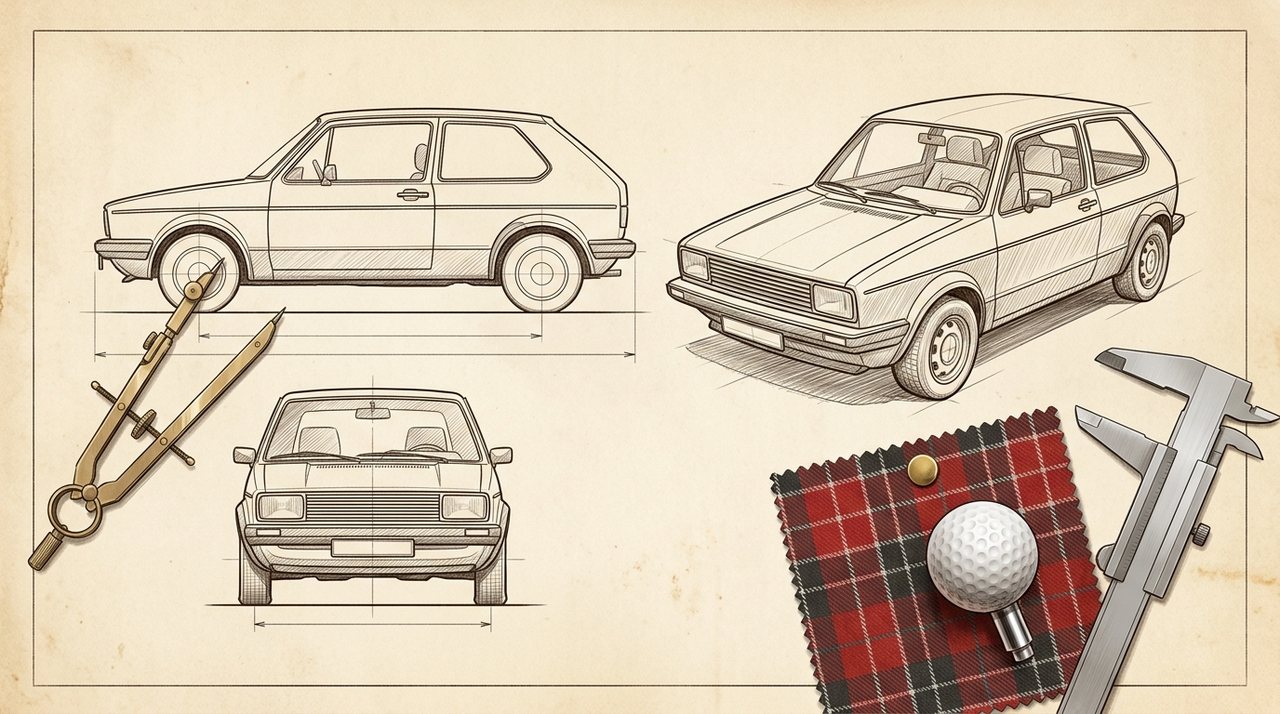
Volkswagen’s own newsroom tells the beginning plainly. In 1974 about half a dozen people inside the company, among them the chief press officer of the day, Anton Konrad, started work on a sporty Golf that nobody had asked them for. Hermann Hablitzel, Board Member for Technology, kept the unofficial project alive and presented it to Board Chairman Toni Schmücker in March 1975 under development order EA195; chief designer Herbert Schäfer added the dimpled golf-ball gear knob before its September 1975 IAA debut and June 1976 German launch at 110 PS.
The plan was modest: about 5,000 cars to recover tooling costs. Volkswagen’s history page puts the final count of the first generation at 461,690. Everything that follows—from inline historical photographs to a 3D WebGL2 MacPherson/VAQ transaxle bench and 15 Scite-checked vehicle-dynamics papers—traces how eight generations solved the same physics limits of power, grip, mass, and stability on a front-wheel-drive compact platform.
Five Engineering Eras · 1974–2026 Continuity Observatory
How Fifty Years Evolved From 810 kg Restraint to Software Coordination
Select each era from the 1974 EA195 side project to 2026 software integration: see the engineering constraint that defined the decade, the mechanical answer adopted, and how earlier cabin craftsmanship endured beside modern electronics.
1 · Lightness & Injection
Anton Konrad, Hermann Hablitzel, Herbert Schäfer (EA195)- Physical limit faced
- Deliver genuine highway pace out of an upright three-door economy shell without luxury-sedan engine displacement or weight.
- Engineering move
- Keep base mass at 810 kg, fit an Audi-sourced 1.6 L 110 PS fuel-injected engine, drop springs 10 mm front / 20 mm rear with anti-roll bars, and sign it with tartan upholstery and the golf-ball knob.
2 · Breathing & Safety
Mk2 (16V & G60) → Mk3 (2.0 L, 16V & TDI)- Physical limit faced
- Regulated three-way catalytic converters shaved top-end breathing (139 PS down to 129 PS on Mk2 16V), while heavier crash structures demanded low-end punch.
- Engineering move
- Moved from two-valve heads to four-valve pent-roof heads (16V), briefly tested belt-driven G-Lader scroll compression (160 PS G60), and introduced ABS brakes alongside heavier Mk3 safety shells.
3 · Boost & Dual Clutches
Mk4 1.8T / VR5 → Mk5 2.0 TFSI & 6-speed DSG- Physical limit faced
- Engine downsizing needed exhaust-driven boost and direct injection for efficiency, yet manual upshifts still interrupted front-wheel traction and dumped boost pressure.
- Engineering move
- Adopted turbocharged 1.8 L and 2.0 L 200 PS petrol powerplants plus coaxial 6-speed DSG wet dual clutches (cutting VW’s 0–100 km/h figure from 7.2 s manual to 6.9 s DSG).
4 · Front-Axle Torque Vectoring
Mk6 XDS (Hans-Joachim Stuck tuning) → Mk7 MQB, VAQ & Clubsport S- Physical limit faced
- Above 200 PS at the front tyres, cornering weight transfer unloads the inside front tyre so an open differential wastes drive into inside wheelspin.
- Engineering move
- Progressed from brake-based inside-wheel clamping (XDS) to an electro-hydraulic multi-plate front differential lock (up to 1,600 Nm), MQB weight cuts up to 42 kg, progressive 2.1-turn steering, and Clubsport S aluminium unsprung reductions (7:49.21 VW record / 7:57 sport auto).
VW 2013 chassis VW Clubsport S Kakalis 2008 sport auto via Wikipedia
5 · Software Fusion & Edition 50
Mk8 Vehicle Dynamics Manager (245 → 265 PS → 325 PS Edition 50)- Physical limit faced
- By 2020 the brake-based lock, clutch-pack e-diff, and adaptive dampers already existed independently—running on separate silos that could fight each other near the limit.
- Engineering move
- A unified Vehicle Dynamics Manager coordinates XDS+, the front lock, and DCC dampers in real time, rising to 265 PS standard (2024) and the 325 PS GTI EDITION 50 announced for 2026.
Part I · Lightness
1976–1983
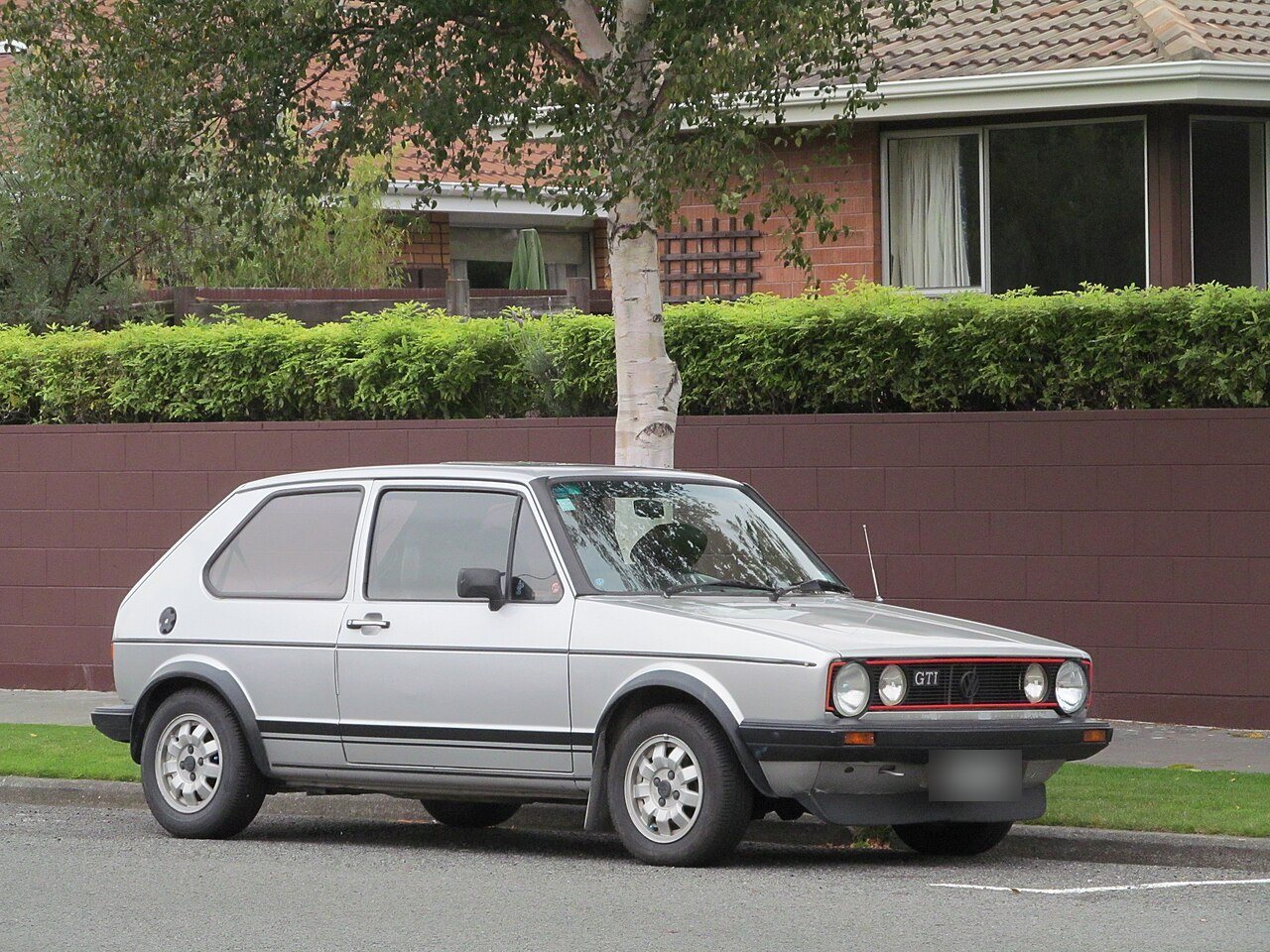
Start with what the first car did not have. VW’s archive lists a base weight of 810 kg, a 1.6-litre engine and 175-section tyres on 13-inch wheels. There was no turbocharger: the GTI was a Golf with a stronger engine, a lower stance and anti-roll bars at both ends. In our reading, the engineering move was restraint.
The archive also records how the car grew up during its run. In 1978 new bumpers with replaceable plastic covers on a metal support made it almost 10 cm longer; right-hand drive arrived in 1979; a redesigned dashboard and larger rear lights came in 1981, the same year a four-door body became available.
Our reading: the engineering move was restraint.
Mk1 1976–1983
Light car, injected engine, firm chassis
VW’s archive describes a 1.6-litre injection engine borrowed from Audi, a base weight of 810 kg, and a chassis set 10 mm lower at the front and 20 mm lower at the rear, with anti-roll bars at both ends. The details that became shorthand for the badge are in the same entry: a red surround on the grille, tartan sports seats and a golf-ball gear knob. The archive also notes, with a wink, that the car’s 175/70 HR 13 tyres carried a speed rating implying more than 180 km/h. That is a tyre rating, not a measured top speed.
- Engine
- 1.6 L injection, from Audi VW Mk1 archive
- Output at launch
- 110 PS VW history
- Base weight
- 810 kg VW Mk1 archive
- Lowered
- 10 mm front / 20 mm rear VW Mk1 archive
Read 2026-11-15
Part II · Breathing
1984–1997
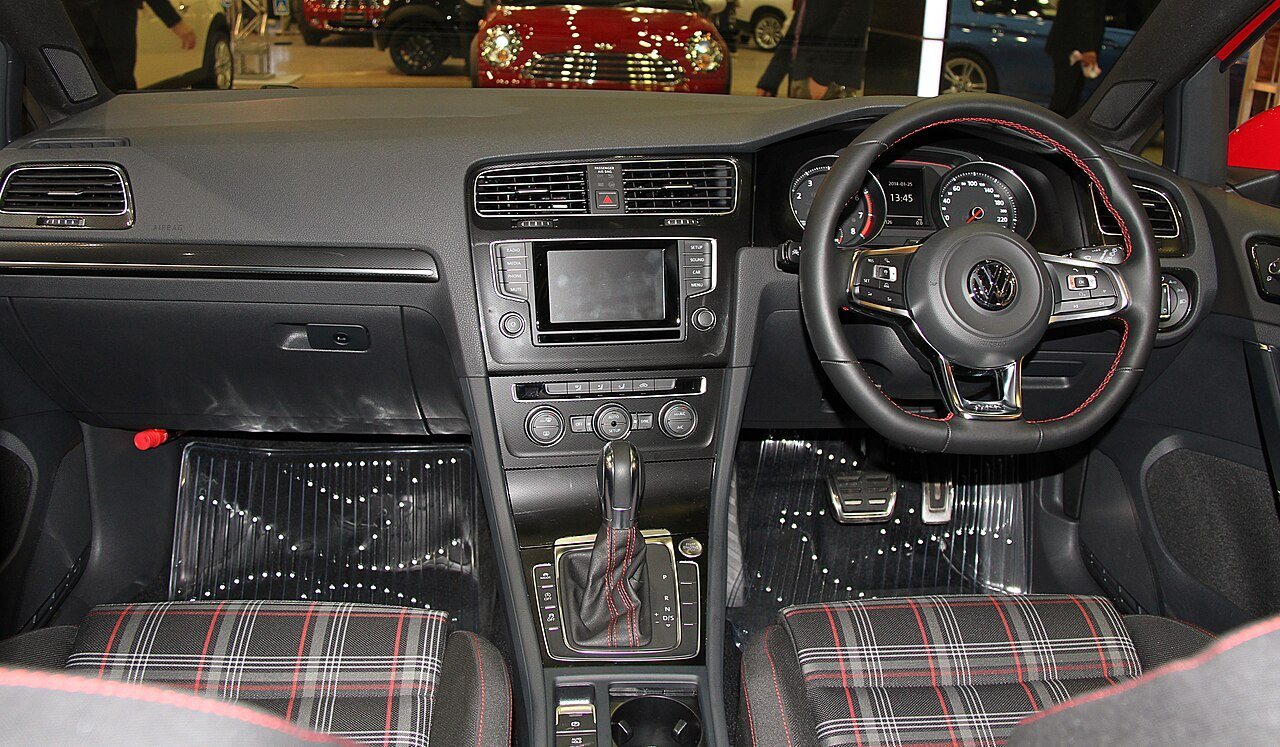
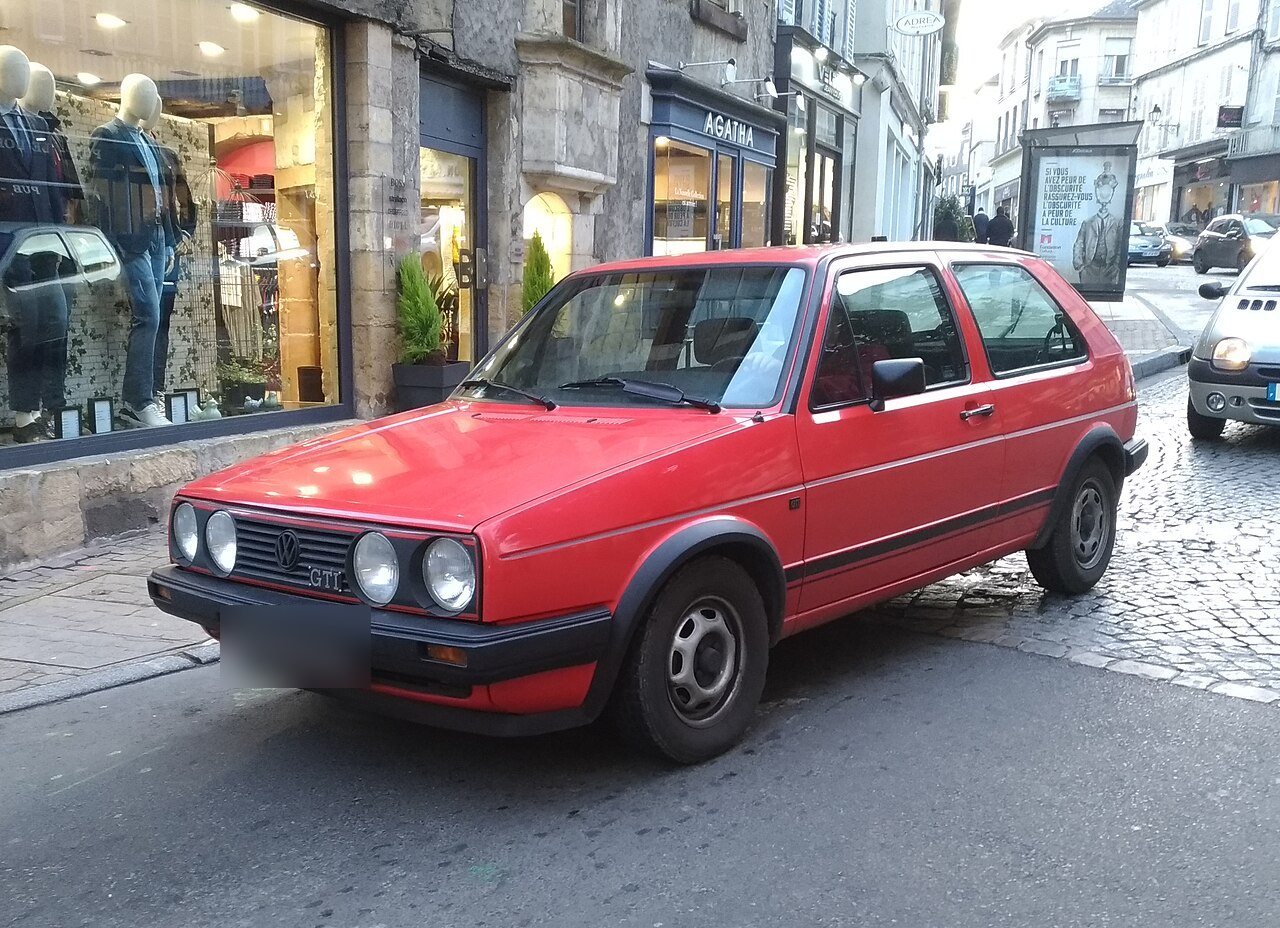
The second and third generations are the story of an engine learning to breathe under new rules. A sixteen-valve head, four valves for each of four cylinders, arrived in 1986, and a catalytic-converter version followed. Volkswagen lists both figures: 139 PS and 208 km/h without a regulated catalyst, 129 PS and 200 km/h with one. Then, in 1990, came a different way to fill the cylinders: the G60’s scroll-type supercharger, driven by the engine itself.
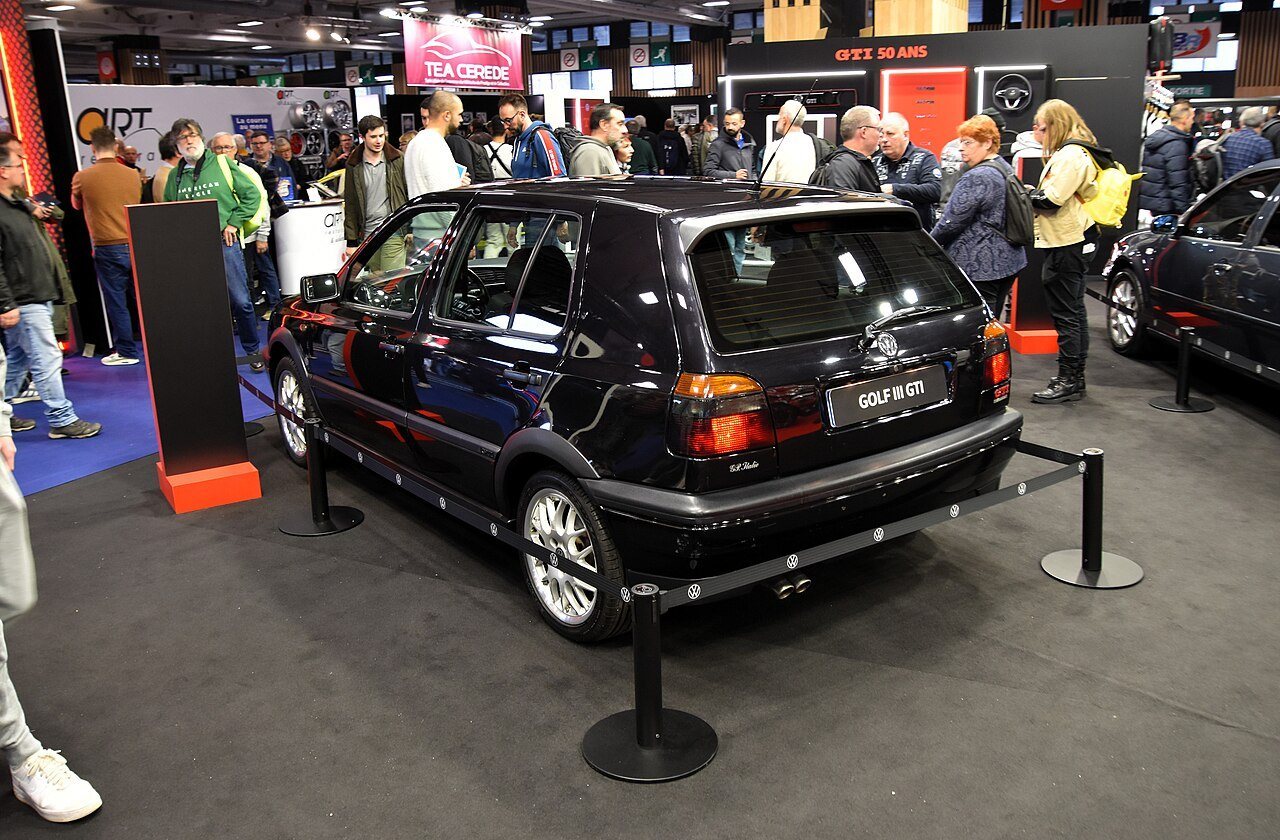
The third generation carried more of everything: VW lists a 2.0-litre engine, a sports chassis with a lowered body, and all the headlight functions in one housing. In 1996 it also carried the first anniversary edition in GTI history and a 110 PS turbodiesel wearing the badge.
139 PS without a regulated catalyst, 129 PS with one: VW’s own figures, side by side.
Mk2 1984–1991
Breathing: sixteen valves, then a supercharger
The second generation started at 112 PS. In 1986 a 16-valve engine arrived: VW lists 139 PS without a regulated catalytic converter and 129 PS with one, a small, honest record of what emissions hardware cost in that era. In 1990 the G60 added a scroll-type “G-Lader” supercharger for 160 PS. VW’s history page also notes that ABS was offered as an option for the first time.
- Output at launch
- 112 PS VW history
- 16V (1986)
- 139 PS · 129 PS with catalyst VW history
- G60 (1990)
- Scroll supercharger, 160 PS VW history
Read 2026-11-15
Mk3 1991–1997
Heavier, safer, and a diesel with the badge
The third generation opened with a 2.0-litre two-valve engine at 115 PS, and a 16-valve version followed at 150 PS (VW pages give 1992 and 1993 for it, so we print neither). In 1996 the badge went onto a 110 PS turbodiesel, and the “20 Years of GTI” edition became, in VW’s words, the first anniversary model in GTI history.
- Output at launch
- 2.0 L 8V, 115 PS VW history
- 16V
- 150 PS VW history
- Turbodiesel (1996)
- 110 PS VW history
Read 2026-11-15
Part III · Pressure
1998–2008
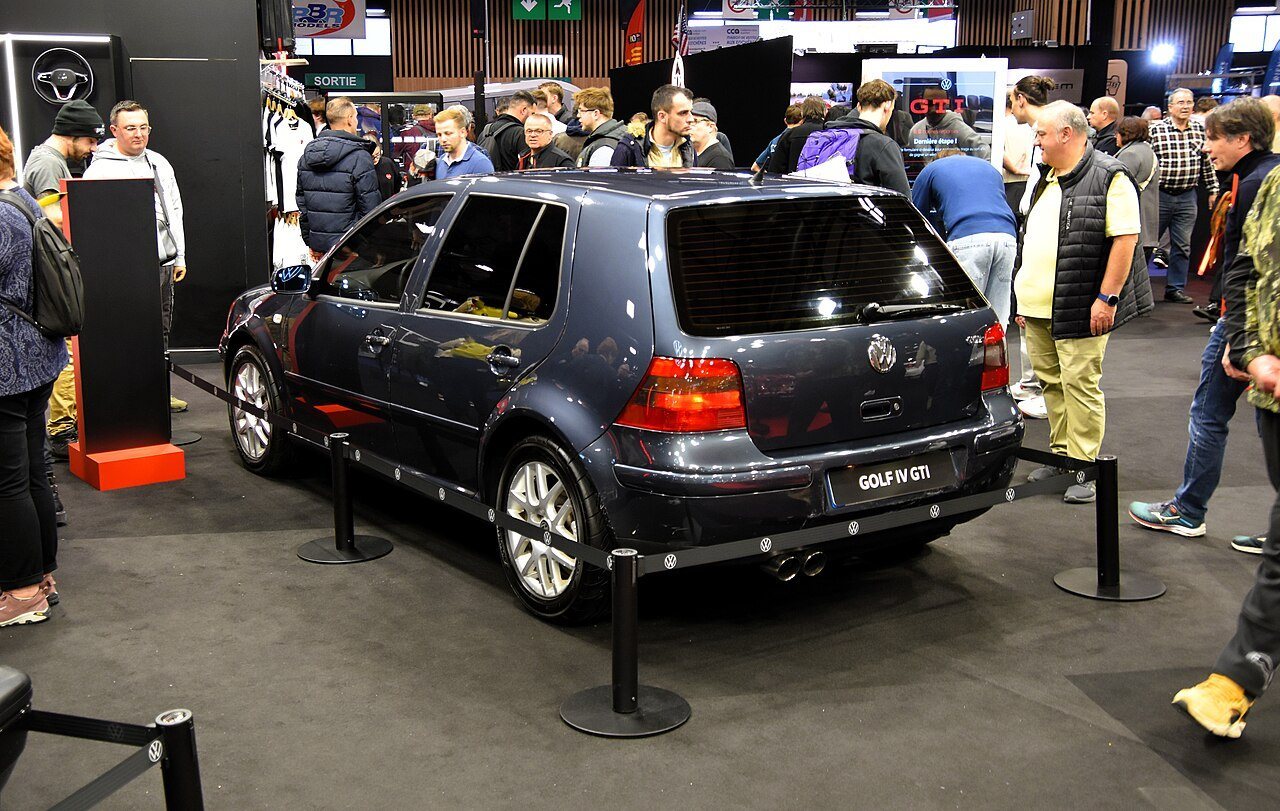
From the fourth generation on, turbocharged petrol engines become the GTI’s main line in VW’s history page: a 1.8-litre turbo in the Mk4, beside a five-cylinder, then turbo engines in the Mk5, Mk6 and Mk8. Why turbo, after the G60 had tried a supercharger? VW does not say; engine researchers summarise the general trade plainly. A supercharger takes its power straight from the crankshaft, which helps the engine respond to the throttle. A turbocharger is driven by the engine’s exhaust flow and is the more widely adopted choice for fuel efficiency, paired with direct fuel injection charge cooling, though it needs a moment to build boost.
Hu et al. 2015 Hu et al. 2016 Zhao et al. 1999
The fifth generation added an optional dual-clutch gearbox, the DSG, that keeps torque flowing during the shift. Its section below lets you run through the gears. VW marked the car’s thirtieth year with the Edition 30 of 2006: 230 PS, 0–100 km/h in 6.8 s, 18-inch wheels, tartan-checked seats and the golf-ball gear knob, and called it the fastest GTI to date.
A supercharger answers the throttle; a turbo answers the fuel bill.
Mk4 1998–2003
The turbo era starts
VW lists a 1.8-litre turbocharged petrol engine at 150 PS for the fourth generation, beside a 2.3-litre five-cylinder, also at 150 PS, that rose to 170 PS in 2000, and turbodiesels from 110 PS to 150 PS. Model names varied by market, so read that list as VW’s, not as one country’s price sheet. The 2001 “25 Years of the GTI” edition used a 180 PS turbocharged engine.
- Turbo petrol
- 1.8 L, 150 PS VW history
- Five-cylinder
- 2.3 L, 150 → 170 PS VW history
- 25 Years (2001)
- 180 PS turbo VW history
Read 2026-11-15
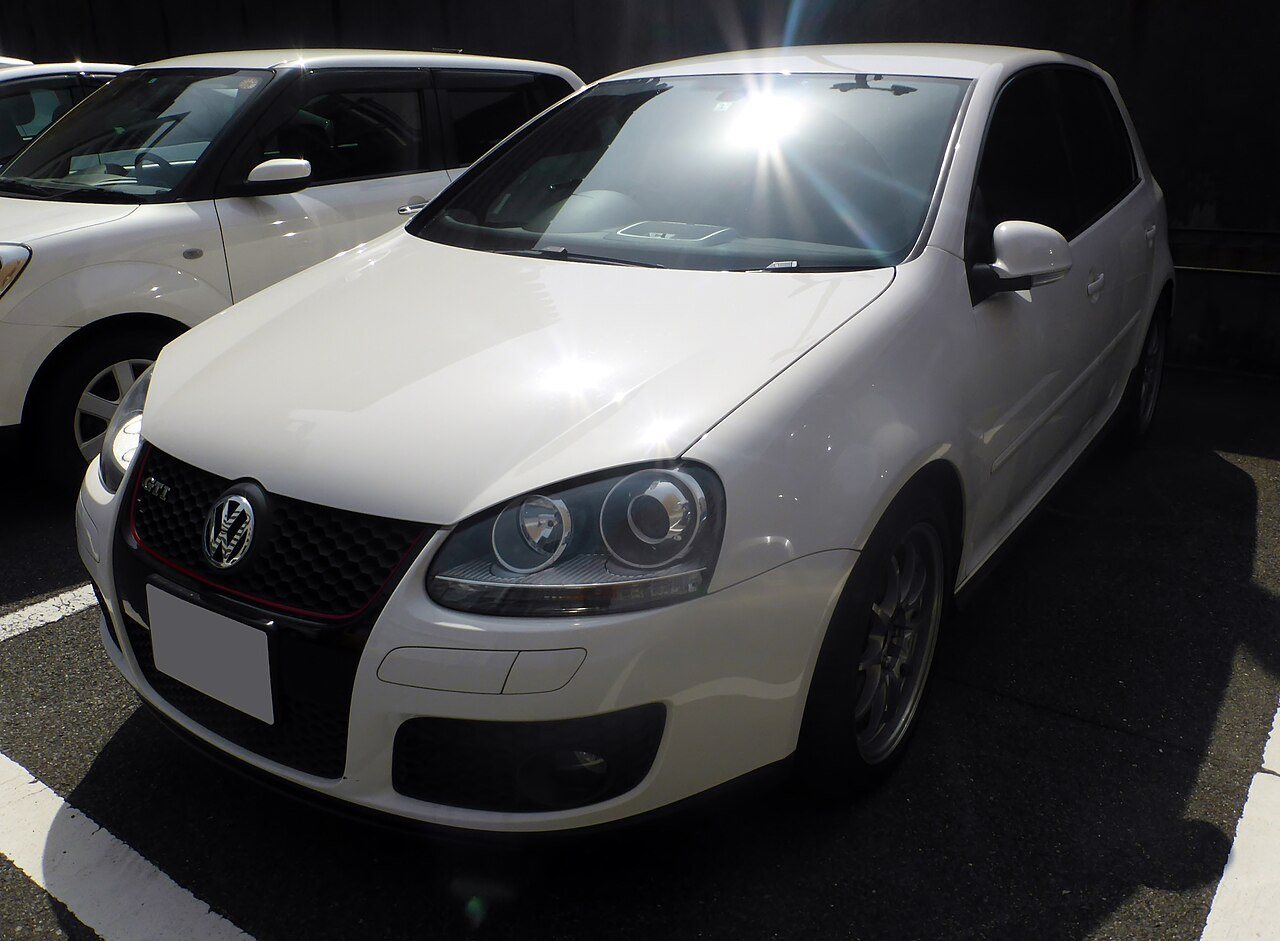
Mk5 2004–2008
Two clutches
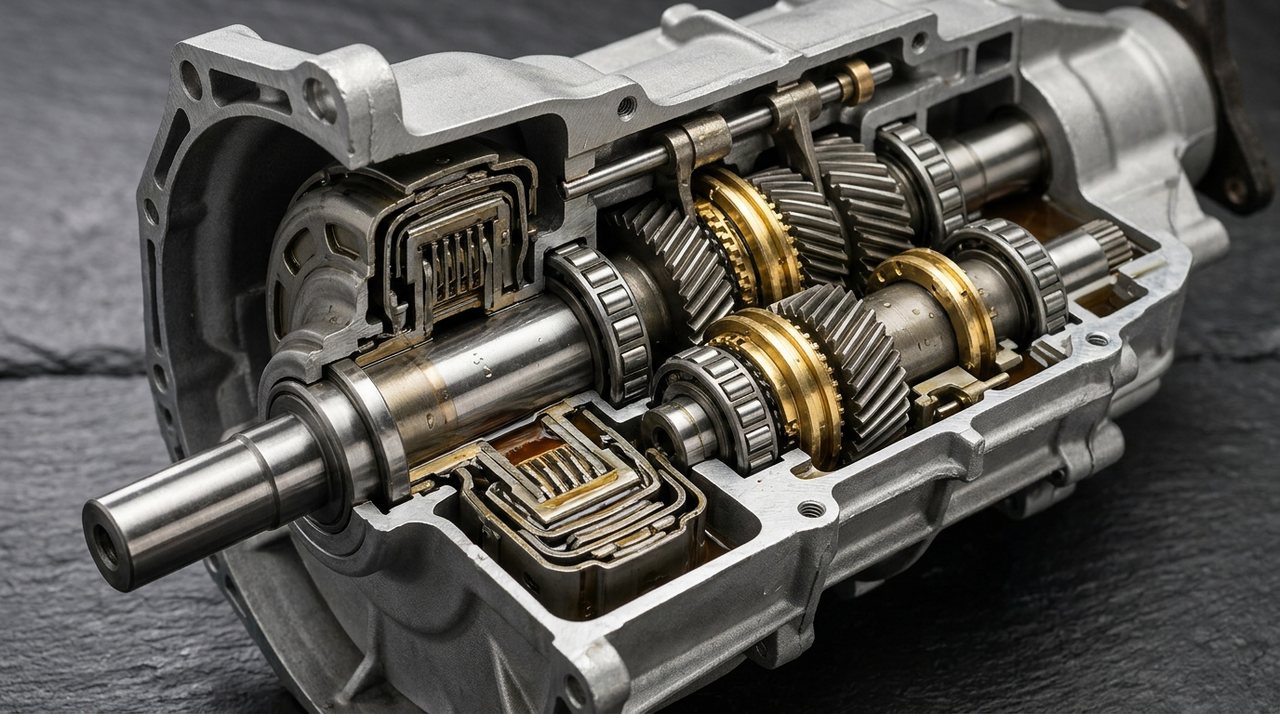
Shown at the Paris Motor Show in September 2004, the fifth generation used a 2.0-litre turbocharged engine at 200 PS. VW offered an optional 6-speed direct-shift gearbox (DSG) and quotes 0–100 km/h in 6.9 s with it against 7.2 s with the manual. The gearbox bench and 3D cutaway below show why two coaxial clutches keep wheel torque continuous across upshifts.
- Engine
- 2.0 L turbo, 200 PS VW history
- Gearbox option
- 6-speed DSG VW Mk5 archive
- 0–100 km/h (VW)
- 7.2 s manual · 6.9 s DSG VW history
Read 2026-11-15
Two clutches
A dual-clutch gearbox is two gearboxes sharing one output: odd gears on one shaft, even gears on the other, each with its own clutch. Press “Shift up” and watch which clutch carries the drive.
First gear on clutch 1. Second is already selected on the even shaft.
What the papers say: Galvagno and colleagues (2011) describe the shift as one clutch letting go while the other engages, so torque keeps flowing to the wheels during the change, after which a synchroniser pre-selects the next gear on the idle shaft. Brancati and colleagues (2023) add a detail worth listening for: with many unloaded gears turning, a dual-clutch box is prone to gear rattle during shifts, and the oil between the teeth damps it. Neither paper tested a Volkswagen gearbox.
Part IV · Grip
2009–2019
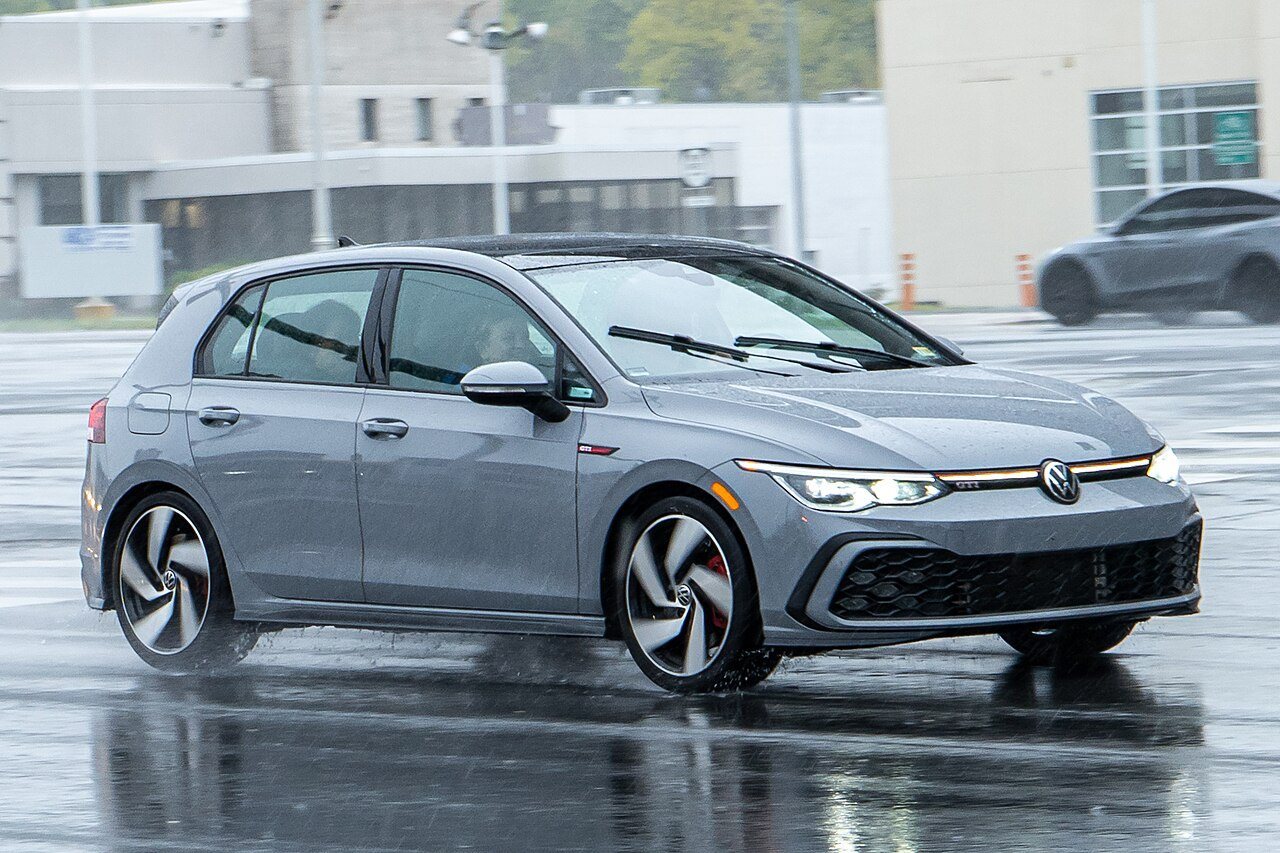
With power past 200 PS through the front wheels, the next problem was putting it down. The sixth generation answered with the brakes: XDS, standard on a GTI for the first time, according to VW. The seventh answered twice, with XDS+ on the standard car and a clutch-pack front differential lock up to 1,600 Nm on the Performance model. VW’s 2013 launch material is unusually detailed about the hardware, and the anatomy and differential sections below walk through it.
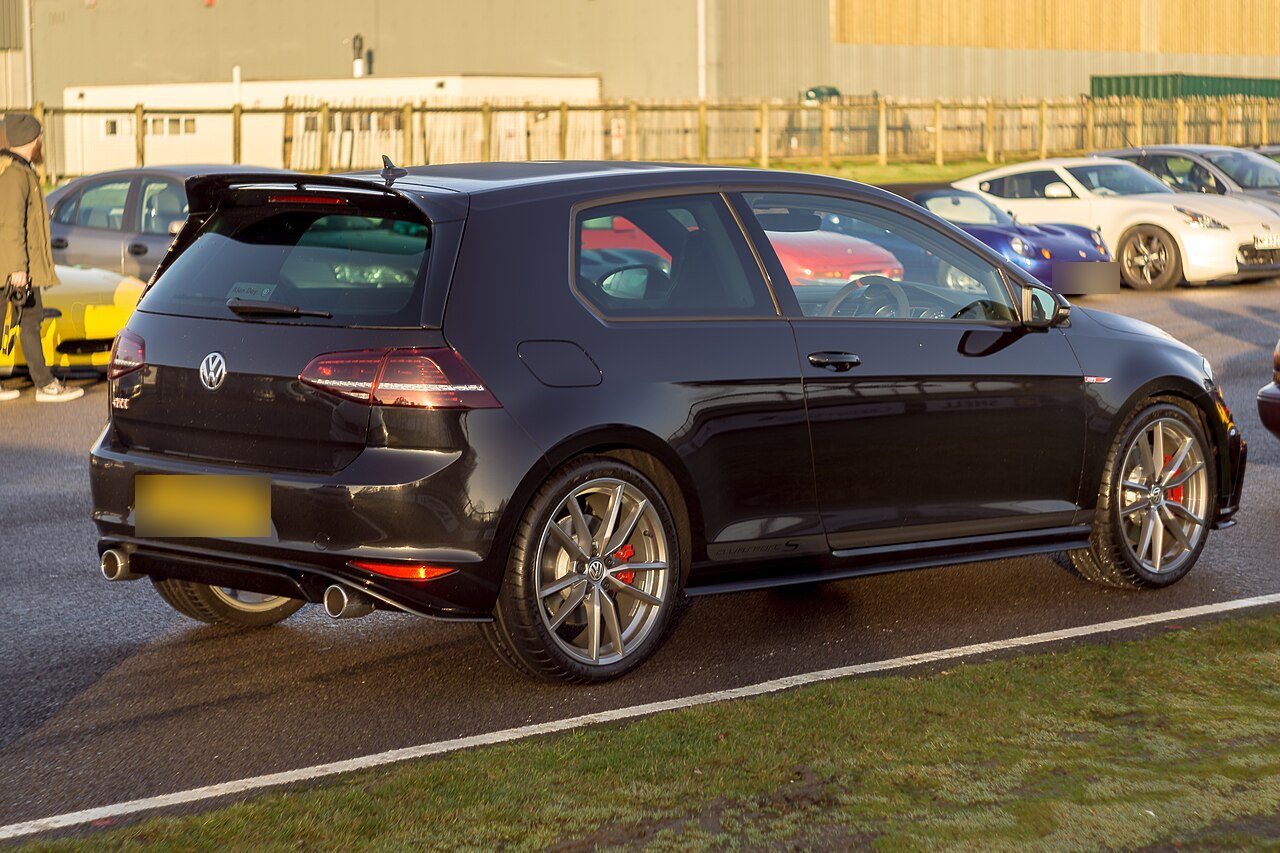
The era also produced the specials. VW lists the Edition 35 of 2011 at 235 PS, the first GTI cabriolet in 2012, the 2016 Clubsport at 265 PS with a temporary boost to 290 PS that VW says was the first GTI to break the six-second mark in its sprint figure, the Clubsport S at 310 PS, and the 2019 GTI TCR at 290 PS.
With 200 PS through the front wheels, the problem stopped being power.
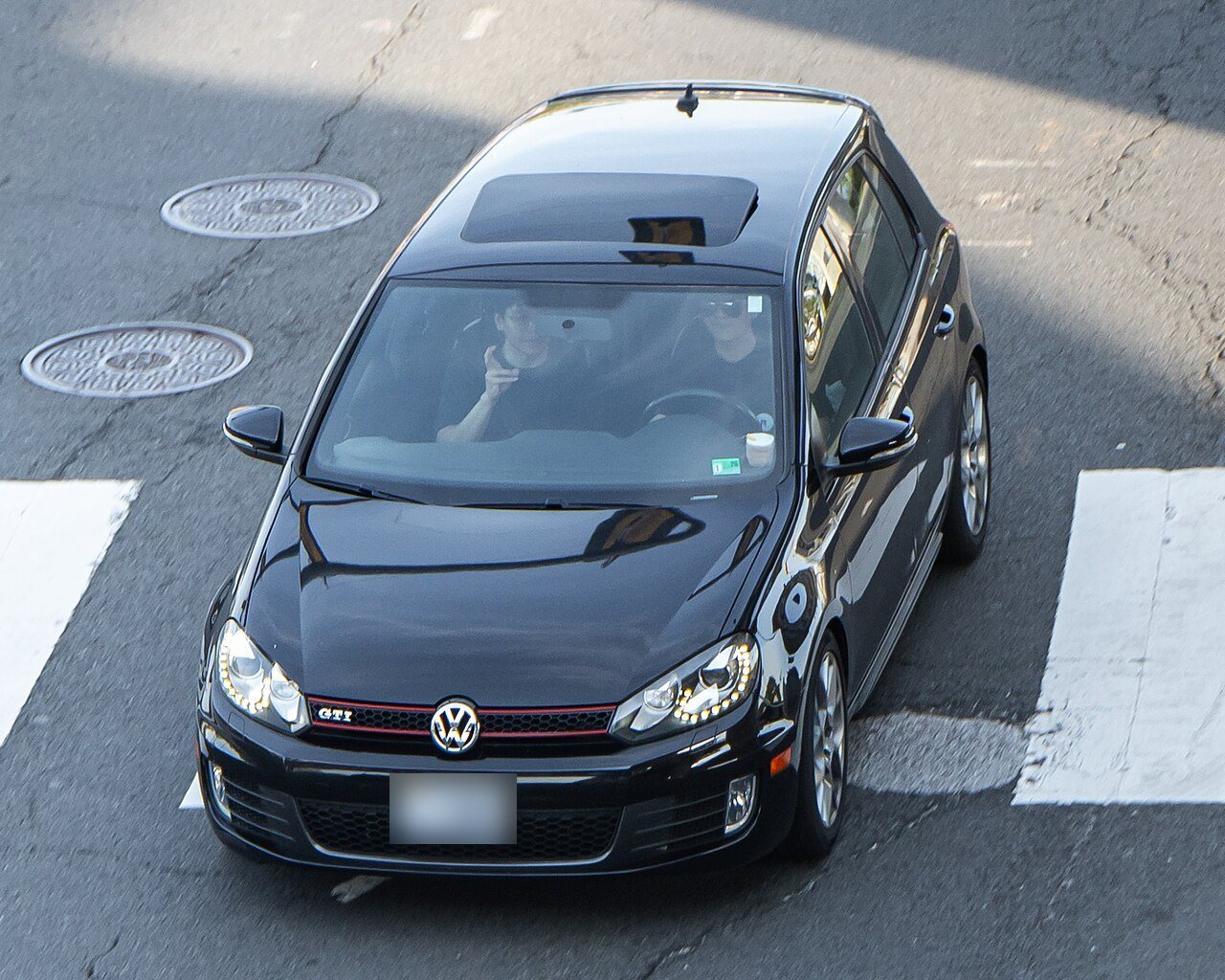
Mk6 2009–2012
Brakes as a differential
The sixth generation made 210 PS. VW says it was the first GTI with the XDS electronic differential lock as standard, and that Hans-Joachim Stuck had a hand in the chassis tuning. XDS does not lock anything mechanically: it brakes the inside front wheel so the open differential’s equal halves allow the loaded outside tyre to hold more drive.
- Output
- 210 PS VW history
- New as standard
- XDS (brake-based) VW history
Read 2026-11-15
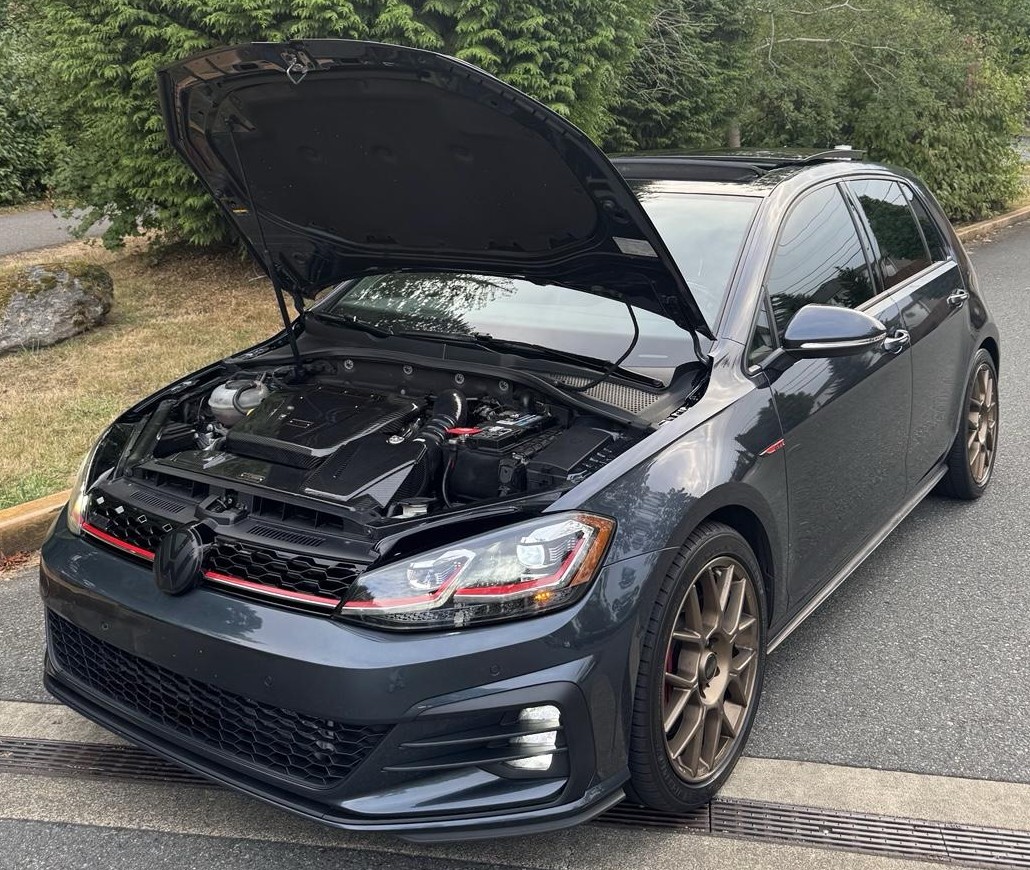
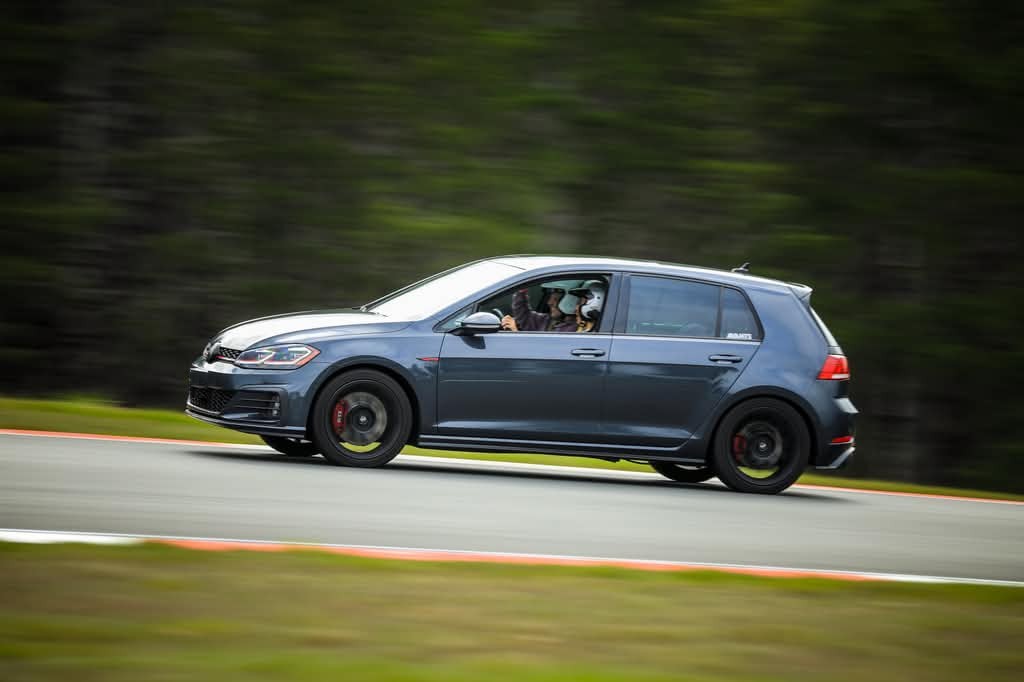
Mk7 2013–2019 · Mk7.5 (2017)
A platform, and a clutch pack at the front axle
The seventh generation sat on Volkswagen’s MQB platform, and VW says the GTI was up to 42 kg lighter than its predecessor. It started at 220 PS, with a GTI Performance at 230 PS. The Performance model added what VW calls a front differential lock: a multi-plate clutch between the right driveshaft and the differential case, squeezed by a piston pump driven by an electric motor, with locking torque up to 1,600 Nm proportional to pump pressure. The standard car used XDS+, which brakes the inside wheels. VW also lists progressive steering (2.1 turns vs 2.75 turns) and a body 15 mm lower than lesser Golfs. The 2017 Mk7.5 facelift brought 230 PS and 245 PS in Europe; in the US it arrived as the 2018 model year at 220 hp.
- Platform
- MQB VW Mk7 archive
- Weight vs Mk6 (VW)
- up to 42 kg lighter VW Mk7 archive
- Front lock (Performance)
- Multi-plate, pump-pressurised VW 2013 chassis
- Steering
- 2.1 turns lock to lock (2.75 on lesser Golfs) VW 2013 chassis
- Facelift (Mk7.5)
- 2017 in Europe VW Mk7 archive
- US model year
- 2018, 220 hp VW US 2018 press kit
Read 2026-11-15
- Front suspension links and bearings 1.6 kg
- Aluminium front pivot bearing 2.8 kg
- Rear suspension 4.0 kg
Volkswagen’s itemised savings against the previous GTI. Our sum: 8.4 kg.
Why chase a few kilograms at the wheels? Unsprung mass is everything the springs do not carry: wheels, tyres, brakes, hubs, part of the links. A 2021 study of in-wheel motors names added unsprung mass as their main drawback because it worsens road holding. That paper is about electric hubs, not hot hatches, but the physics is the same reason Volkswagen itemised these savings.
VW gives about 2.1 turns lock to lock for the GTI’s progressive steering and prints 380° beside it, against 2.75 turns (500°) for the standard rack of lesser Golfs. The wheels here turn by those printed degree figures.
The differential bench
Under power in a tight corner, a front-wheel-drive car shifts weight off its inside front tyre. With an ordinary open differential, that light wheel spins and the engine’s torque goes nowhere useful. Pick a strategy and press the throttle.
Throttle closed: both wheels grip.
Computed, not measured: arrow lengths follow the Mechanics Lab model in Part VI, whose inputs are MODEL values except Volkswagen’s 1,600 Nm locking torque.
Why the clutch pack sends torque outward: a 2008 SAE paper on brake-based torque vectoring explains that a clutch-type (semi-active) differential can only move torque from the faster wheel to the slower one, and that brakes can create a yaw moment even with a free differential. When the inside wheel starts to spin, it is the faster one, so the clutch pack moves torque to the outside wheel, which matches Volkswagen’s description of shifting torque from the wheel with less grip to the one with more. The paper studied a rear-drive sports car, not a Golf.
Part V · Software
2020–2026
The eighth generation’s headline is a controller. VW describes a vehicle dynamics manager that coordinates the brake-based XDS+, the optional adaptive dampers and the front differential lock as one system. The hardware ideas are the ones earlier generations introduced one at a time; on VW’s description, what is new is that software decides how they work together.
VW lists the Clubsport 45 of 2021 at 300 PS, a 2024 update that raised the standard car to 265 PS, and the GTI EDITION 50, shown at the 2025 Nürburgring 24-hour race, at 325 PS for a 2026 launch.
The hardware ideas are old; the new part is who decides.
Mk8 2020–2026
Software as chassis
The eighth generation launched with a 2.0-litre turbo at 245 PS and 370 Nm and a seven-speed DSG. VW describes a new vehicle dynamics manager, used in a GTI for the first time, that coordinates the XDS+ brake-based lock, the optional DCC adaptive dampers and the front differential lock. In 2024 the standard car rose to 265 PS, with the front lock standard on every model, and VW announced the GTI EDITION 50 at 325 PS for a 2026 launch, which it calls the most powerful Golf GTI to date.
- Output at launch
- 245 PS · 370 Nm VW history
- Gearbox
- 7-speed DSG VW history
- 2024 update
- 265 PS VW history
- Announced 2026 milestone
- EDITION 50 · 325 PS VW history
Read 2026-11-15
Dual-Scale Chassis Plate · 1:20 Front Bay ↔ 1:5 Detail Loupe
Inspect the Front-Wheel-Drive Hardware Across Four Spatial Nodes
Front-wheel-drive performance lives inside one crowded transverse front bay sharing steering, suspension, drive torque, and braking. Pick any node on the 1:20 schematic to inspect its 1:5 engineering detail.
MacPherson Strut & Camber Geometry (1:20 ↔ 1:5)
1:20 ↔ 1:5The damper tube doubles as the upper steering pivot axis between lower ball joint and top strut bearing; kingpin inclination keeps scrub radius small during simultaneous braking and cornering (Cronin 1981; general mechanism, did not test a Golf).
Right-Halfshaft Electro-Hydraulic Clutch Pack (Up to 1,600 Nm)
1:20 ↔ 1:5Seated on the right driveshaft outside the open differential carrier, pump pressure squeezes multi-plate discs to shift torque up to 1,600 Nm toward the loaded outside front wheel without burning service brake pads.
Coaxial Odd/Even Input Shafts & Wet Clutches (6-Speed / 7-Speed)
1:20 ↔ 1:5Odd gears spin on the inner solid shaft via Clutch 1 while even gears run on the coaxial outer hollow sleeve via Clutch 2—allowing synchronous handover shifts with uninterrupted wheel thrust.
340 × 30 mm Ventilated Disc, Aluminium Carrier & Steering Rack
1:20 ↔ 1:5Shaving 1.6 kg in front links and 2.8 kg at aluminium pivot bearings lifts the tyre wheel-hop natural frequency above body bounce so rubber holds rough tarmac; progressive variable teeth tighten the rack to 2.1 turns.
Coupled 2D ↔ 3D Observatory · Chassis & Transaxle Workbench
From Lateral Weight Transfer to 3D Hardware (Live GLB & DXF Export)
Adjust lateral cornering acceleration (0.00 g to 0.90 g) and axle torque demand on the left: the 2D traction-ellipse schematic recomputes inside/outside front wheel load shift N_in / N_out, available tyre grip μ·N·r, and net direct yaw moment M_z—steering the 3D WebGL2 front assembly on the right live. Switch between all 4 hardware views (MacPherson Strut, VAQ Clutch Differential, Coaxial Dual-Clutch Shafts, and Twist-Beam vs. Multi-Link Corner) and export valid binary .glb or R2000 .dxf geometry directly.
MODEL N_in = 2600 N · N_out = 5400 N · T_road = 2400 Nm · M_z = 1.77 kN·m
3D VAQ assembly ready · Yaw M_z = 1.77 kN·m
Tire force saturation follows the nonlinear Pacejka slip-load framework (1992), differential torque vectoring yaw stabilization is formalized in Abe et al. (2001) and Rubin & Arogeti (2015), and integrated brake/e-diff/damper coordination in Trächtler (2004). None of those studies measured a Golf GTI; numeric bench readouts reflect the MODEL parameters in Part VI.
Pacejka & Bakker 1992 Abe et al. 2001 Rubin & Arogeti 2015 Trächtler 2004
Where Does the Engine’s Torque Go Under Cornering Unloading?
Compare the exact Part VI 3,000 Nm axle demand across the unloaded left-hander (inside tyre holds 832 Nm, outside holds 1,728 Nm MODEL limits): an open differential caps road tractive torque at 1,664 Nm (1,336 Nm wasted in inside spin), whereas the 1,600 Nm VAQ clutch pack delivers 2,560 Nm directly to the tarmac with zero brake heat.
MODEL Flow (VAQ 1,600 Nm Clutch Pack): 3,000 Nm demand -> 832 Nm inside road + 1,728 Nm outside road = 2,560 Nm net drive (440 Nm excess held at engine limit) · Brake heat = 0 Nm
| Strategy | Road Drive | Brake / Unused |
|---|---|---|
| VAQ 1,600 Nm | 2,560 Nm | 0 Nm |
| XDS+ | 2,164 Nm | 500 Nm |
| Open | 1,664 Nm | 1,336 Nm |
6-Axis Vehicle-Dynamics Envelope · MODEL Comparative Index (0–100)
How Five Eras Expanded Traction Without Abandoning Compact Packaging
Toggle across GTI engineering eras on this illustrative 0–100 MODEL comparative index (reflecting published subsystem evolution, not independent instrumented lap telemetry): Mk1 maximized low-mass feedback, Mk5 bridged shift-torque gaps, and Mk7/Mk8 unlocked corner-exit front traction via MQB stiffness and e-diff control.
Vehicle Dynamics Manager fuses XDS+, front differential lock, and adaptive DCC dampers ahead of the 325 PS EDITION 50.
Ghost race: nineteen years on one circuit
Lap-time lists usually mix manufacturers’ record runs, magazines and amateurs. This one does not. Every time below comes from one German magazine, sport auto, timing a Golf GTI on the Nürburgring Nordschleife for its Supertest, from the 2002 “25 Jahre GTI” to the 2021 Clubsport 45. Press start and all eight run at once.
- Mk4 · Golf IV GTI “25 Jahre GTI” (2002)
- Mk5 · Golf V GTI DSG (2005)
- Mk6 · Golf VI GTI “35 Jahre GTI” (2011)
- Mk7 · Golf VII GTI Performance (2013)
- Mk7 · Golf VII GTI Clubsport (2016)
- Mk7 · Golf VII GTI Clubsport S (2016)
- Mk7 · Golf VII GTI TCR (2019)
- Mk8 · Golf VIII GTI Clubsport “45 Jahre GTI” (2021)
Eight cars on the grid.
Schematic loop, not the Nordschleife’s shape. Each dot runs at the constant average speed its lap time implies; real laps speed up and slow down. Time is compressed 100 to 1. Hollow dots mark rows where the list leaves the track length blank.
| # | Gen | Car, as listed | Year | Output | Lap | Driver | Tyres | Configuration |
|---|---|---|---|---|---|---|---|---|
| 1 | Mk4 | Golf IV GTI “25 Jahre GTI” | 2002 | 180 PS | 8:54 | Horst von Saurma | not stated | blank |
| 2 | Mk5 | Golf V GTI DSG | 2005 | 200 PS | 8:53 | Horst von Saurma | Michelin Pilot Exalto | blank |
| 3 | Mk6 | Golf VI GTI “35 Jahre GTI” | 2011 | 235 PS | 8:38 | Horst von Saurma | Dunlop Sport Maxx GT | blank |
| 4 | Mk7 | Golf VII GTI Performance | 2013 | 230 PS | 8:29 | Horst von Saurma | Bridgestone Potenza S001 | blank |
| 5 | Mk7 | Golf VII GTI Clubsport | 2016 | 265 PS | 8:07 | Christian Gebhardt | Michelin Pilot Sport Cup | 20,600 m |
| 6 | Mk7 | Golf VII GTI Clubsport S | 2016 | 310 PS | 7:57 | Christian Gebhardt | Michelin Pilot Sport Cup 2 | 20,600 m |
| 7 | Mk7 | Golf VII GTI TCR | 2019 | 290 PS | 8:04.92 | Christian Gebhardt | Michelin Pilot Sport Cup 2 N0 | 20,600 m |
| 8 | Mk8 | Golf VIII GTI Clubsport “45 Jahre GTI” | 2021 | 300 PS | 8:02.66 | Christian Gebhardt | Michelin Pilot Sport Cup 2 N0 | 20,600 m |
What the numbers say, in our arithmetic: the 2016 Clubsport S was 57 seconds quicker than the 2002 car on the same magazine’s lap, and the regular-production GTI improved by 25 seconds between the 2002 and 2013 tests. The specials of 2016 to 2021 sit within ten seconds of each other.
Same magazine and circuit, not the same day: tyres, drivers, weather and track surface changed over nineteen years, and the older rows are listed to the second. sport auto uses a 20,600 m configuration, about 200 m shorter than a full lap; the list states it for the 2016 to 2021 rows and leaves it blank for the older ones. Volkswagen’s own 7:49.21 record run for the Clubsport S was a different, manufacturer-run test and is not part of this comparison. No sport auto times for the Mk1, Mk2 or Mk3 are in the list: not stated.
For Automotive & Chassis Engineers · Kinematic Grammar & Academic Lineage
How Chassis Engineers Study Front-Wheel-Drive Dynamics (1974–2026)
Why does a transverse front-engine hatchback feel balanced rather than nose-heavy? Automotive engineers dissect the layout across four coupled subsystems—paired below with a constructive specifications ledger and six landmark peer-reviewed papers (all checked in Crossref and Scite with zero retractions, explicitly distinguishing general dynamics theory from VW’s published factory specs).
MacPherson Strut & Steering Axis
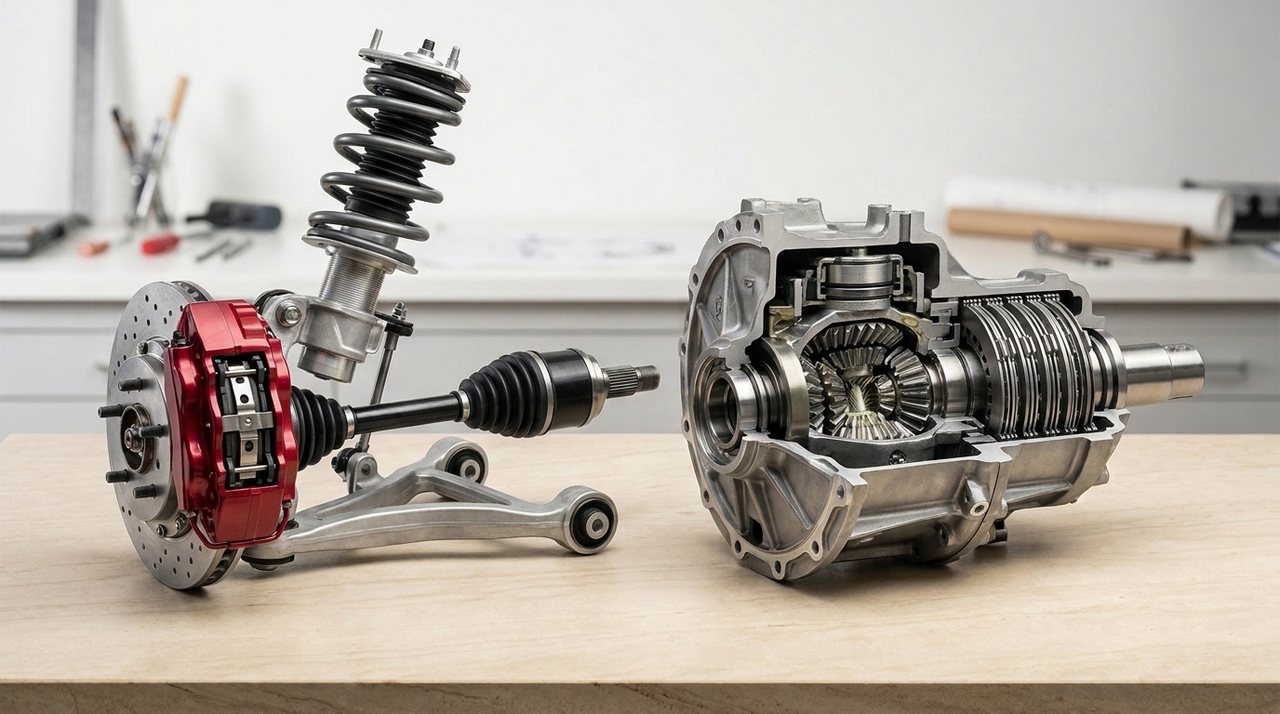
Compact spring-damper pillar plus lower control arm saves transverse engine-bay width while tuning kingpin inclination and caster trail against torque steer.
All 8 GTI generations; Mk7 progressive variable-pitch rack (2.1 turns)
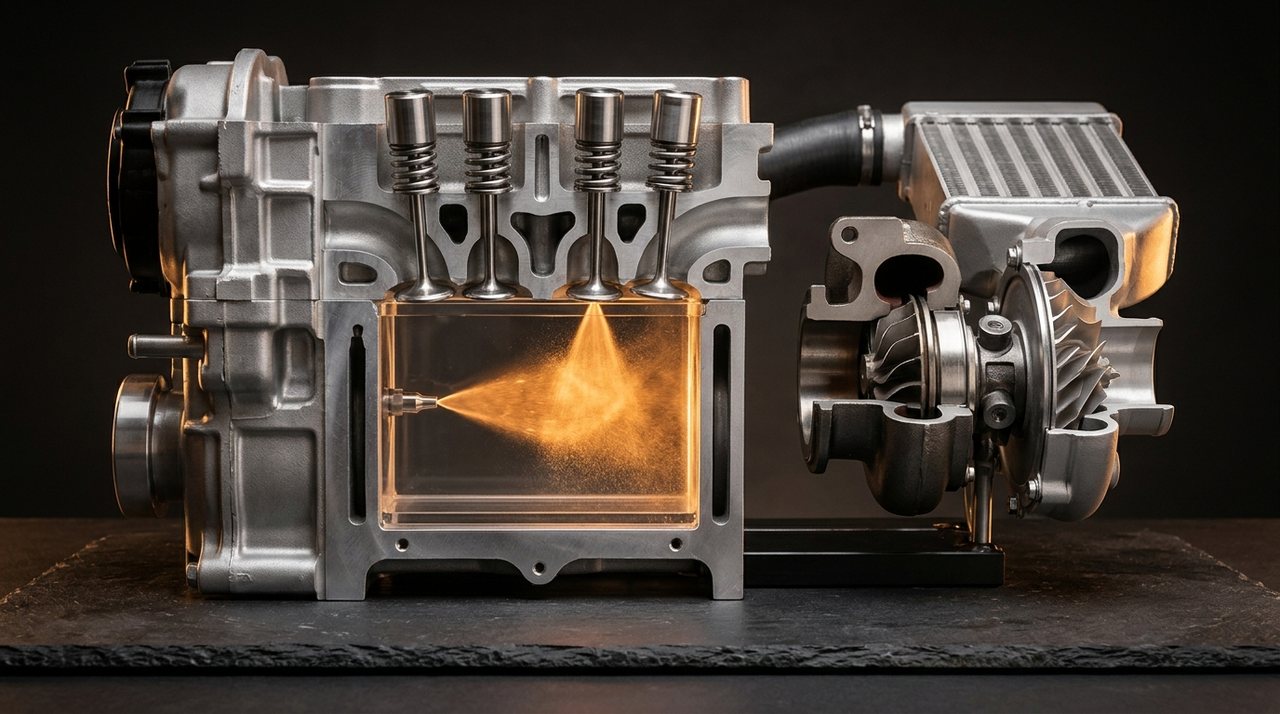
GDI Evaporative Charge & Exhaust Boost
Spraying fuel inside the cylinder cools intake air via latent heat, raising knock-limited compression tolerance alongside high-efficiency exhaust turbines.
2.0 L turbo petrol architecture (Mk5 200 PS → Mk8 265 PS / 325 PS)
Coaxial Dual-Clutch & Electro-Hydraulic VAQ
Odd and even shafts share one differential crown; multi-plate wet clutches swap shafts under overlap while VAQ routes up to 1,600 Nm outward in corners.
Mk5–Mk8 DSG + Mk7 Performance / Mk8 standard front lock
Modular Rear Compliance & Quarter-Car Mass
Transitioning to multi-link rear kinematics separates toe control from vertical bumps while light aluminium hubs keep high-frequency wheel hop separated from body bounce.
MQB modular multi-link rear & Clubsport S aluminium subframe/carriers
Chassis & Powertrain Constructive Grammar
| Subsystem Ratio | GTI / Published Value | Engineering Rationale | Source |
|---|---|---|---|
| Launch lightness datum | 810 kg base · 110 PS | Restraining vehicle weight yields sharper transients than adding displacement alone. | VW Mk1 archive |
| Stance drop over standard Golf | 10 mm front / 20 mm rear (Mk1) · 15 mm (Mk7) | Lower roll center and shorter spring travel cut lateral load transfer ΔF_z. | VW Mk1 archive |
| MQB structural mass delta | up to 42 kg lighter (Mk7 vs Mk6) | Hot-formed steels recover torsional stiffness without paying weight penalty. | VW Mk7 archive |
| Variable progressive steering | 2.1 turns lock-to-lock vs 2.75 turns | Calm center on highway merges smoothly into rapid lock-to-lock apex turn-in. | VW 2013 chassis |
| Front differential lock limit | 1,600 Nm max multi-plate clutch torque | Transfers drive strictly from faster inside tyre toward loaded outside tyre. | VW 2013 chassis |
| Itemized corner mass savings | 1.6 kg + 2.8 kg + 4.0 kg = 8.4 kg | Raises unsprung wheel-hop mode above body bounce for cleaner tarmac contact. | VW 2013 chassis |
| Integrated dynamics supervision | XDS+ + front lock + DCC (245 → 325 PS) | Prevents brake vectoring, e-diff, and damping actuators from counteracting each other. | VW history |
Vehicle-Dynamics Scholarship Lineage (1974–2026) · Click Any Station
Select each peer-reviewed station to inspect the governing physics inside engines, struts, tyres, dual clutches, active differentials, and global chassis controllers. Explicit scope tags mark general theory studies that did not test a Golf GTI.
Karnopp, Crosby & Harwood (1974) + Hać & Youn (1992) · Semi-Active Damping
Karnopp et al. (ASME J. Eng. Ind. 1974) · Hać & Youn (J. Vib. Acoust. 1992)Introduced the skyhook damping concept: switching damper orifice resistance faster than body heave periods reconciles isolating sprung-mass heave with restraining unsprung wheel hop—the exact mathematical ancestry behind modern millisecond-rate adaptive DCC dampers.
Scope: General quarter-car semi-active vibration control studies; neither study tested a Golf GTI.
D. L. Cronin (1981) · Exact 3D Kinematics of MacPherson Struts
D. L. Cronin (Mechanism and Machine Theory 1981)Formulated exact nonlinear kinematic constraint equations for MacPherson front suspensions—quantifying camber curve changes, caster precession, track scrub, and anti-dive/lift vectors without resorting to small-angle approximations across full wheel travel.
Scope: General multibody strut kinematics paper; did not analyze or test a Golf GTI.
H. B. Pacejka & E. Bakker (1992) · The Magic Formula Tyre Model
Pacejka & Bakker (Vehicle System Dynamics 1992)Captured longitudinal traction, lateral cornering stiffness, self-aligning torque, and vertical-load sensitivity inside compact trigonometric curves—showing mathematically why loading an outside front tyre grows peak grip less than proportionally (load sensitivity), so splitting torque equitably maximizes total axle thrust.
Scope: Semi-empirical tyre physics framework; did not publish VW Golf GTI tyre test coefficients.
Zhao, Lai & Harrington (1999) + Hu et al. (2015) · Direct Injection & Boost
Zhao et al. (Prog. Energy Combust. Sci. 1999) · Hu et al. (IJER 2015)Explained why in-cylinder fuel vaporization draws heat directly out of compressed intake charge (charge cooling), raising knock threshold on boosted four-cylinder engines so higher cylinder pressures stay reliable at low engine speed.
Scope: General spark-ignition GDI and downsized-turbo engine reviews; neither tested a VW engine.
Fichera et al. (2004) + Galvagno (2011) · Rear Torsion Beam & Coaxial Clutches
Fichera, Lacagnina & Petrone (2004) · Galvagno et al. (2011)Coupled multibody kinematics maps torsion-beam roll steer vs. independent links on compact hatches (explaining why higher-output trims moved from Mk1–Mk4 twist beams to Mk5–Mk8 multi-link), while Galvagno’s kinematic-dynamic equations model zero-torque-loss powershift clutch crossings.
Scope: Generic torsion-beam and dual-clutch multibody papers; did not model VW Golf tolerances directly.
Abe (2001), Trächtler (2004) & Rubin (2015) · Active Diffs & Vehicle Dynamics Control
Abe et al. (2001) · Trächtler (2004) · Rubin & Arogeti (2015)Showed that generating a deliberate right-left longitudinal force couple produces a fast stabilizing yaw moment near peak lateral g—and why supervisory model-predictive coordinators (matching the philosophy of Mk8’s Vehicle Dynamics Manager) prevent brake clamping, clutch locking, and damping actuators from fighting each other.
Scope: Control-theory and chassis integration articles outside VW; did not test any Golf GTI hardware.
Part VI · Mechanics Lab: five models, worked in the open
Model · Derived · Verified by script
The story above describes what each generation did. This part puts equations to five mechanisms behind those moves: front differential torque split, Nordschleife lap average speeds, two-mass corner frequencies, lateral cornering load transfer with yaw couple, and coaxial dual-clutch powershift handover. Any input not from a primary source is marked MODEL; skills/classics/cc01/verify_cc01_mechanics.py recomputes and checks every figure.
1 · Why an open differential runs out of grip
An open differential gives each driven wheel half the axle torque. A wheel can only push the road as hard as its grip allows, roughly the friction coefficient times the load on it times the wheel radius. In a hard corner the inside front wheel carries less load, so its limit is lower, and because both halves must stay equal, the whole axle is capped at twice that smaller limit. Brake the inside wheel and the differential can hold more torque before that wheel spins, so the outside wheel gets more. A clutch pack instead moves torque directly from the faster, spinning wheel to the slower one, up to its locking torque. Volkswagen gives 1,600 Nm for the Mk7 GTI Performance front lock. The table runs the same three cases at 3,000 Nm demand.
T_road,max(open) = 2 · μ · N_in · rT_road(lock) = T_in + min(ΔT, 1,600 Nm, μ · N_out · r − T_in)
| Strategy | Inside wheel | Outside wheel | Brake | To the road |
|---|---|---|---|---|
| Open differential | 832 Nm | 832 Nm | 0 Nm | 1,664 Nm |
| XDS+ brake | 832 Nm | 1,332 Nm | 500 Nm | 2,164 Nm |
| Clutch-pack lock | 832 Nm | 1,728 Nm | 0 Nm | 2,560 Nm |
Inputs (MODEL): axle torque demand 3,000 Nm, wheel radius 0.32 m, friction coefficient 1.0, inside load 2,600 N, outside load 5,400 N, brake up to 500 Nm. Locking torque 1,600 Nm (VW). Grip limits: inside 832 Nm, outside 1,728 Nm.
2 · Lap times as average speeds
Divide the lap length by the lap time and you get an average speed. The source gives the 20,600 m sport auto configuration only for the 2016 to 2021 rows, so only those four get a speed here; the older rows stay blank rather than borrow a length the list does not state. These are DERIVED values, our arithmetic, and an average hides every braking zone and straight.
v̄ = 20,600 m ÷ t_lap
| Gen | Car, as listed | Year | Lap | Average (DERIVED) |
|---|---|---|---|---|
| Mk7 | Golf VII GTI Clubsport | 2016 | 8:07 | 152.3 km/h |
| Mk7 | Golf VII GTI Clubsport S | 2016 | 7:57 | 155.5 km/h |
| Mk7 | Golf VII GTI TCR | 2019 | 8:04.92 | 152.9 km/h |
| Mk8 | Golf VIII GTI Clubsport “45 Jahre GTI” | 2021 | 8:02.66 | 153.6 km/h |
3 · Unsprung mass and the two ways a corner bounces
Engineers model one corner of a car as two masses and two springs: the body on the suspension spring, and the wheel on the tyre. The model has two natural frequencies, a slow body bounce and a fast wheel hop, found from the masses and stiffnesses. Research on this model reports that unsprung mass mainly moves the wheel-hop mode, tyre stiffness mainly shapes it too, and suspension stiffness sets the bounce; less wheel hop means better road holding. Move the slider to change the unsprung mass and watch which frequency moves. The rates are MODEL values, not a Golf’s.
m_s·m_u·ω⁴ − (m_s(k_s + k_t) + m_u·k_s)·ω² + k_s·k_t = 0, f = ω / 2π
40 kg · body bounce 1.27 Hz · wheel hop 12.5 Hz
Inputs (MODEL): sprung mass 350 kg, suspension rate 25,000 N/m, tyre rate 220,000 N/m.
Micromachines 2026 Ahmadian & Pare 2000 Woo & Shin 2021 Karnopp et al. 1974 Hać & Youn 1992
4 · Lateral weight transfer & direct yaw moment M_z
Across increasing lateral acceleration a_y from straight acceleration (0.00 g) to 0.70 g cornering, vertical load shifts linearly off the inside tyre onto the outside tyre. An open differential stays symmetric (0 kN·m yaw assist) while shifting torque asymmetrically with XDS+ (500 Nm brake limit) or the 1,600 Nm VAQ lock generates an outward tractive force difference (F_out − F_in) across a 1.54 m MODEL track width.
M_z = ((T_out − T_in) / r_w) · (b_f / 2)
| Lateral g & Strategy | Loads N_in / N_out (MODEL) | Wheel Torque In / Out | Road Total | Yaw Couple M_z |
|---|---|---|---|---|
| 0.00 g · VAQ (straight) | 4000 N / 4000 N | 1,200 / 1,200 | 2,400 | 0.00 kN·m |
| 0.70 g · Open differential | 2600 N / 5400 N | 832 / 832 | 1,664 | 0.00 kN·m |
| 0.70 g · XDS+ (500 Nm max brake) | 2600 N / 5400 N | 832 / 1,200 | 2,032 | 0.89 kN·m |
| 0.70 g · VAQ (1,600 Nm max lock) | 2600 N / 5400 N | 832 / 1,568 | 2,400 | 1.77 kN·m |
5 · Coaxial dual-clutch ratio spacing & handover kinematics
On a MODEL 6-speed gearbox shifting at 6,000 rpm under 280 Nm crankshaft torque across a 0.20 s clutch handover overlap, lower gears carry steeper step drops Δω that require larger friction dissipation in the wet clutch packs while output tractive torque remains unbroken across every upshift.
E_slip = 0.5 · T_in · |Δω| · t_overlap
| Upshift | Ratio Step (MODEL) | Speed Drop Δrpm | Next-Gear Axle Torque | Overlap Slip Energy |
|---|---|---|---|---|
| 1→2 | 3.46 → 2.05 | 2445 rpm | 2,330 Nm | 7.17 kJ |
| 2→3 | 2.05 → 1.30 | 2195 rpm | 1,478 Nm | 6.44 kJ |
| 3→4 | 1.30 → 0.90 | 1846 rpm | 1,023 Nm | 5.41 kJ |
| 4→5 | 0.90 → 0.72 | 1200 rpm | 818 Nm | 3.52 kJ |
| 5→6 | 0.72 → 0.58 | 1167 rpm | 659 Nm | 3.42 kJ |
Complete Visual Archive · 9 Commons Photos + 5 Studio Cutaways
Inspect Every Generation Photograph & Mechanical Cutaway Fullscreen
Filter between nine verified Wikimedia Commons photographs (PD / CC0 / CC BY; private street plates obscured) across Mk1–Mk8 plus five clearly labeled conceptual studio illustrations, or open any frame inside the zero-jump fullscreen plate viewer.
CC.01 · Golf GTI Chassis, Boost & Transaxle Crossword
Inspired by classic broadsheet crosswords: test your command of CC.01’s governing laws and historical turning points. Switch to ES-MX in the masthead to unlock a completely independent Spanish crossword with its own grid and scientific vocabulary.
Across
Down
Select any cell or clue and type A–Z. Space toggles Across/Down; progress auto-saves to localStorage.
Across fifty years the answers changed almost completely: eight valves to sixteen, natural aspiration to a supercharger and then direct-injection turbos, one clutch to two, an open differential to brakes and then a 1,600 Nm clutch pack, and finally software coordinating all of it. The brief, as we framed it, stayed put.
Sources
All read on 2026-11-15. VW marks a Volkswagen statement; Press marks independent coverage; Paper marks 15 peer-reviewed articles checked in Crossref and Scite on the same day with zero retractions (general mechanisms, none tested these cars); Photo Archive marks Wikimedia Commons photographs under PD, CC0, or CC BY attribution.
- VW Volkswagen Newsroom, “The history of the Golf GTI in detail”
- VW Volkswagen Newsroom, “Golf I GTI (1976–1983)” archive entry
- VW Volkswagen Newsroom, “Golf GTI Mk1” (history of the new Golf GTI: Anton Konrad, Hermann Hablitzel, Toni Schmücker, Herbert Schäfer, development order EA195)
- VW Volkswagen Newsroom, “Golf V GTI (2004–2008)” archive entry
- VW Volkswagen Newsroom, “New Golf GTI: running gear, layout and electronics” (2013)
- VW Volkswagen Newsroom, “Golf VII GTI (2013–2019)” archive entry
- VW Volkswagen of America Media, “2018 Golf GTI press kit” (220 hp at 4,700 rpm, 258 lb-ft, all trims)
- VW Volkswagen Newsroom, “Ten key facts: the Golf GTI Clubsport S”
- Paper Hu, Akehurst & Brace (2015). Novel approaches to improve the gas exchange process of downsized turbocharged spark-ignition engines: A review. International Journal of Engine Research 17(6), 595–618
- Paper Hu, Turner, Akehurst et al. (2016). Observations on and potential trends for mechanically supercharging a downsized passenger car engine: a review. Proc. IMechE Part D 231(4), 435–456
- Press Wikipedia, “List of Nürburgring Nordschleife lap times” (rows citing sport auto Supertests 01/2002, 11/2005, 09/2011, 08/2013, 07/2016, 12/2019, 11/2021); raw text read 2026-11-15
- Paper Scamarcio, Caponio, Mihalkov et al. (2023). Predictive Anti-Jerk and Traction Control for V2X Connected Electric Vehicles With Central Motor and Open Differential. IEEE Transactions on Vehicular Technology 72(6), 7221–7239
- Paper Electromechanical Modeling and Dimensionless Optimization of a Multilayer PZT-5H Energy Harvester for Vehicle Suspension Systems (2026). Micromachines 17(10), 1111
- Paper Ahmadian & Pare (2000). A Quarter-Car Experimental Analysis of Alternative Semiactive Control Methods. Journal of Intelligent Material Systems and Structures 11(8), 604–612
- Press CarAdvice, “Volkswagen Golf GTI Clubsport S breaks front-drive Nürburgring lap record” (2016)
- Paper Galvagno, Velardocchia & Vigliani (2011). Dynamic and kinematic model of a dual clutch transmission. Mechanism and Machine Theory 46(6), 794–805
- Paper Brancati, Pagano, Rocca et al. (2023). Dynamic Behaviour of an Automotive Dual Clutch Transmission during Gear Shift Maneuvers. Applied Sciences 13(8), 4828
- Paper Kakalis, Zorzutti, Cheli et al. (2008). Brake Based Torque Vectoring for Sport Vehicle Performance Improvement. SAE Int. J. Passenger Cars – Mechanical Systems 1(1), 514–525
- Paper Woo & Shin (2021). A Double Sky-Hook Algorithm for Improving Road-Holding Property in Semi-Active Suspension Systems for Application to In-Wheel Motor. Applied Sciences 11(19), 8912
- Paper Karnopp, Crosby & Harwood (1974). Vibration Control Using Semi-Active Force Generators. Journal of Engineering for Industry 96(2), 619–626
- Paper Cronin, D. L. (1981). MacPherson strut kinematics. Mechanism and Machine Theory 16(6), 631–644
- Paper Pacejka, H. B. & Bakker, E. (1992). The Magic Formula Tyre Model. Vehicle System Dynamics 21(S1), 1–18
- Paper Hać, A. & Youn, I. (1992). Optimal Semi-Active Suspension with Preview Based on a Quarter Car Model. Journal of Vibration and Acoustics 114(1), 84–92
- Paper Zhao, F., Lai, M.-C. & Harrington, D. L. (1999). Automotive spark-ignited direct-injection gasoline engines. Progress in Energy and Combustion Science 25(5), 437–562
- Paper Abe, M., Kano, Y., Suzuki, K., Shibahata, Y. & Furukawa, Y. (2001). Side-slip control to stabilize vehicle lateral motion by direct yaw moment. JSAE Review 22(4), 413–419
- Paper Fichera, G., Lacagnina, M. & Petrone, F. (2004). Modelling of Torsion Beam Rear Suspension by Using Multibody Method. Multibody System Dynamics 12(4), 303–316
- Paper Trächtler, A. (2004). Integrated vehicle dynamics control using active brake, steering and suspension systems. International Journal of Vehicle Design 36(1), 1–12
- Paper Rubin, D. & Arogeti, S. A. (2015). Vehicle yaw stability control using active limited-slip differential via model predictive control methods. Vehicle System Dynamics 53(9), 1315–1330
- Photo Archive Wikimedia Commons, “File:1982 Volkswagen Golf GTi (Mk1) (14072934454).jpg” (Riley, Christchurch NZ; Creative Commons CC BY 2.0; registration plate obscured)
- Photo Archive Wikimedia Commons, “File:Volkswagen Golf GTI interior.jpg” (TTTNIS; Public Domain)
- Photo Archive Wikimedia Commons, “File:VW Golf II GTI (40516249732).jpg” (Guillaume Vachey; Creative Commons CC0 1.0 Public Domain Dedication; registration plate obscured)
- Photo Archive Wikimedia Commons, “File:Volkswagen Golf III GTI (1996) (55082249962).jpg” (Charles; Creative Commons CC0 1.0 Public Domain Dedication)
- Photo Archive Wikimedia Commons, “File:Volkswagen Golf IV GTI (2002) (55083147451).jpg” (Charles; Creative Commons CC0 1.0 Public Domain Dedication)
- Photo Archive Wikimedia Commons, “File:Volkswagen GOLF V GTI front.JPG” (Tokumeigakarinoaoshima; Creative Commons CC0 1.0 Public Domain Dedication)
- Photo Archive Wikimedia Commons, “File:Volkswagen Golf GTI (Mk VI) Washington DC Metro Area, USA.jpg” (OWS Photography; Creative Commons CC BY 4.0; registration plate obscured)
- Photo Archive Wikimedia Commons, “File:Volkswagen Golf GTI Clubsport S (31059402673).jpg” (Adam Court; Creative Commons CC BY 2.0; registration plate obscured)
- Photo Archive Wikimedia Commons, “File:Volkswagen Golf GTI (Mk VIII) Washington DC Metro Area, USA (1).jpg” (OWS Photography; Creative Commons CC BY 4.0)


Not affiliated with or endorsed by Volkswagen AG. Volkswagen, Golf and GTI are trademarks of Volkswagen AG, used here only to identify the cars. Original schematics and 15 Crossref/Scite-checked peer-reviewed papers (zero retractions) explain mechanisms in general; numbers marked MODEL illustrate physics only. For learning, not buying, tuning or driving advice.